Showing posts with label Germany. Show all posts
Tuesday, 6 June 2023
Oestrogen rules!
I was going to revisit here a train trip I took from New Delhi to Agra, way back in 1980, prompted by the appallingly tragic triple train crash that's just happened in India. But of course that would be somewhat appalling too - insensitively trivialising and tone-deaf. So instead I'm going to write about war as a tourist attraction.Today is the anniversary of D-Day, after all. And who hasn't done a tour of northern France and not been to the beaches, visited Dunkirk, been awed by the white crosses stretching away into the distance at the cemeteries, marvelled at still being able to see the remains of the Mulberry harbour at Arromanches? It's hugely sobering to see it all, stand on the edge of a bomb crater, read the info boards, and imagine the horror of it all - but it's also, be honest, fascinatingly interesting, dramatic and thus, yes, entertaining.Wherever you (ie I) go in the world, there are wartime (and worse) 'attractions' - I honestly couldn't count the battlefields and war cemeteries I've visited, from Gallipoli to Gettysburg, Adelaide River to Bourail in New Caledonia. Plus Stalag Luft III and, even worse, Auschwitz and the Hanoi Hilton. These places have an irresistible appeal that's a weird combination of honest reverence and regret for all those lives lost and pain inflicted, and a creepy fascination for viewing the utter depths of cruelty that men (it's always men) are driven to by their overwhelming desire for power and territory.And, though I suppose it's possible to travel the world and have holidays that don't include stuff like this, it's always there, pretty much wherever you go. The tourist industry isn't backward in pointing that out and, yes, exploiting it openly with focussed tours and suchlike. Their main customers are, of course, Baby Boomers, whose parents lived through WW2 - I wonder, once we've all shuffled off , whether younger generations will be quite so interested?I'm guessing yes. After all, war has been a constant throughout human history, and is certainly front-and-centre right now, with the distinct possibility of others looming, despite the deservedly quite distracting threats of climate change. Do you ever wonder how different things might have been/might be if there were a bit less testosterone swirling through the people in charge around the world?
Wednesday, 4 March 2020
Ich erinnere mich...
Aaaand another free (never free) lunch on a visiting cruise ship bites the dust, thanks to coronavirus. A few weeks ago it was Oceania Regatta, today it was dear old (actually quite new) Silver Muse, which regular 😃 readers will recall I spent Christmas and New Year on, starting in sunny Lyttelton and ending in smoky Sydney. Understandably, in these paranoid times, cruise companies are not keen on inviting large groups of potentially germy visitors on board - and it's quite likely to be mutual, given the current unfortunate image of cruise ships as bug incubation centres. So that's that.
Instead, I shall turn my attention to the packaging material that protected a couple of Villeroy and Boch vintage Acapulco eggcups I bought at auction, which arrived today. I was aware that the seller was German ("Familie Schultz" as the vendor name was a bit of a giveaway) and had indulged in a tiny smattering of Deutsch in the emails with Detlev - but it was a treat to unfold four pages from the inner sections of a surprisingly recent issue of the Frankfurter Allgemeine, which, if anyone ever asked me would be the sole German newspaper I could name. Name, not actually read, I have to add. My German is distant and very rusty, and all those long compound nouns are daunting to tackle.
I'm pleased to report, though, that my one day exploring Frankfurt back in 2011, when I was passing through on an Avalon river cruise, was notable for successful verbal exchanges with the locals. It helps enormously, I find, that being now so far from my rigid school days, I'm pretty relaxed about grammar and mistakes. I don't judge foreigners for their English errors - I'm just glad they're making the effort - and I reckon it cuts both ways. It also helped that I was initially wandering the city with a new friend, who I thought I might as well try to impress by asking directions as soon as we went ashore. Gratifyingly, it worked.
I liked Frankfurt, despite the guide I had later being somewhat disparaging about it as an ugly, reconstructed city. My standards for urban architecture are, by nationality (oldest stone building in NZ? 1832) less exacting, and I was charmed. It was old and pretty, plus new and striking, it felt safe and relaxed, everyone I met was nice, and I thoroughly enjoyed my visit. Of course, the Apfelwein helped, as it always does...
Wednesday, 19 June 2019
R D Robinson for God (unquote)
I've just finished reading When Running Made History by Roger Robinson. I'm not a runner. I was pretty fast as a kid, but that was very long ago, and now I rarely do even the downhill jogs that were an integral part of my morning routine until Tom Cruise ruined that for me (if you want to hear that story, you'll have to ask, regular 😃 reader).
No, the initial reason I read the book was purely because RDR was one of my lecturers at Canterbury University back in 1974, and the one who made the greatest impression on me during the whole four years I was at varsity. He was different from the others: English, droll, effortlessly learned, but also lean and fit. He made academia seem glamorous. It also helped that the subject was English III - The Novel, and he was lecturing us on Vanity Fair, Wuthering Heights, Middlemarch, Tess of the d'Urbervilles, Our Mutual Friend and North & South, amongst others. That sort of brilliance would reflect well on anyone. But Dr Robinson was so comfortable in those writers' company, so familiar with them, so clear-eyed about their failings, and also so honestly admiring of their achievements, that they all merged together, members of some enviable club of literary greatness which we mere students just peered in at through the windows.
I wasn't the only one smitten. I know of others who worked tenuous references to The Loneliness of the Long-Distance Runner into their essays about the narrative role of Nelly Dean, or didacticism in nineteenth-century literature, in the hope of ingratiating themselves with a man we all knew ran marathons. I never stooped so low. So I've never forgotten going to his office to pick up my marked (handwritten!) essay and getting a grin and a "Super-good!" as he handed it over. And I kept the essay, warmed to the core by the margin comment about my style, and the final one about my cogent argument and fluent writing. The sliding off-topic criticism, not so much; though it was, and still is, accurate, I'm perfectly comfortable with admitting. I've made it my thing, actually.
Anyway, the book. I'm not going to review it properly, because that would be stretching the remit of this blog - but it is entertaining, and interesting, and very readable, and much more relevant to non-runners than you might expect. RDR (can't call him Roger. Or Robinson) traces the growth of running as, originally, an eccentric past-time/obsession mostly through his own lifetime but with historical references, right up to the present where it's both an unremarkable everyday habit and an important sport. He shows how running links with, demonstrates, even drives, some important social changes during that time. What really makes the story riveting, though, is his fortuitously - or possibly not - being on the spot for a number of major events - not just world record-breaks, but internationally pivotal things like the fall of the Berlin Wall, 9/11 and the Boston Marathon bombings.
So that's interesting whoever you are - but, for me, there's the extra enjoyment of so many of the places he mentions where he's run, or reported on running, being part of my life experience, too. From Wellington to Ross-on-Wye, Central Park to Hyde Park, Rome to Sydney, Kenya to Christchurch - every couple of pages, there was a ping! of recognition, and instant mental transportation. And that, of course, is what this blog is about, eh: connections.
Thursday, 4 April 2019
Umm...
I've been revisiting Australia. Not in person, you understand, but through the media of my notebooks and photos, and, to a much lesser extent, my memory. The impetus for this was a call from one of my editors for content to fill an Aussie-special issue coming up. "I can do that!" I thought. "I've been there so often, I've used it up! I've been everywhere!"
And (referring you here to the title of this blog), that's no way an exaggeration. I've been sent there for work many times, all over the continent, from the Tiwi Islands to Tasmania, from Ningaloo to the Great Barrier Reef. So you'd think coming up with story material would be a piece of cake. But - you'll have guessed this already - it wasn't. See, the thing is, you forget, don't you? Stuff merges, or evaporates entirely, and flicking through the notes and the pics is almost a revelation: Oh, yeah, that camel ride! The beanie festival! Boab trees! All those bats!
Maybe this is why those pedestrian types keep going back to the Gold Coast every year: because the detail slips out of their memories within weeks of getting back home, and all they remember is that they had a good time. So they're like my old grandmother, who had a pile of Agatha Christies by her bed that she just read one after the other, instantly forgetting each plot so that it was fresh next time she got to it.
That's fine for them, but what about me? I've been to so many amazing places that I'll never get back to, and it's all disappearing. Yes, yes, I'm getting old, I can't even remember where I left my phone or what was on the shopping list I forgot to take to the supermarket with me; but this is serious!
Is this why people have latched onto Instagram with such fervid zeal? Is it not really so much about impressing their friends, as compiling a file of memory aids? And writing blogs, ditto? A propos of which, it's a marvel to me that Moleskine (WHY that final e? Drives me crazy!) maintains such a presence in fancy stationery shops. People may buy those elegant notebooks with great intentions, but I've never seen anyone writing in one - whereas me, with my trusty Back to School-5c-special 3B1s, I'm jotting stuff down all the time.
Because I'm doing it on the run, though, they're untidy and scribbled, and full of destination-specific abbreviations that seem so obvious to me at the time, and which are totally unintelligible when I'm trying to decipher them back home again. I'm never going to sit down with one and read it like a book. Equally, I'm not going to set my editing program to Slideshow and just lie back to watch - mainly because I take so many photos that whittling them down back home is just too daunting a job and so I lazily just file them all away, with the result that the good stuff is smothered by all the crap shots. (Speaking of which, have you ever seen a professional photographer at work and noticed HOW MANY shots they take, constantly referring to their screens to review them? Maybe they're checking their histograms, but it still looks to me as though they're winging it. Shouldn't they know what settings to use?)
And there's another downside to fading travel memories: now and then, when my brain's in neutral (so, quite often, actually) I'll get a sudden vivid impression of somewhere I've been - a town square, a castle, some lookout - and it'll drive me crazy for ages trying to remember where it was. Lisbon? Rudesheim? Santiago? Honestly, the choice is so wide and the memory so tenuous, quite often I never get to the answer.
What's the solution? Don't go to so many places? Yeah, right. Only go to strikingly individual places, like Antarctica or Easter Island? Take clearer notes? Do memory-improvement exercises? Or just shrug and accept the loss and the drawing-in of the borders? Cripes. Depressing, much?
Tuesday, 27 January 2015
Seventy years on
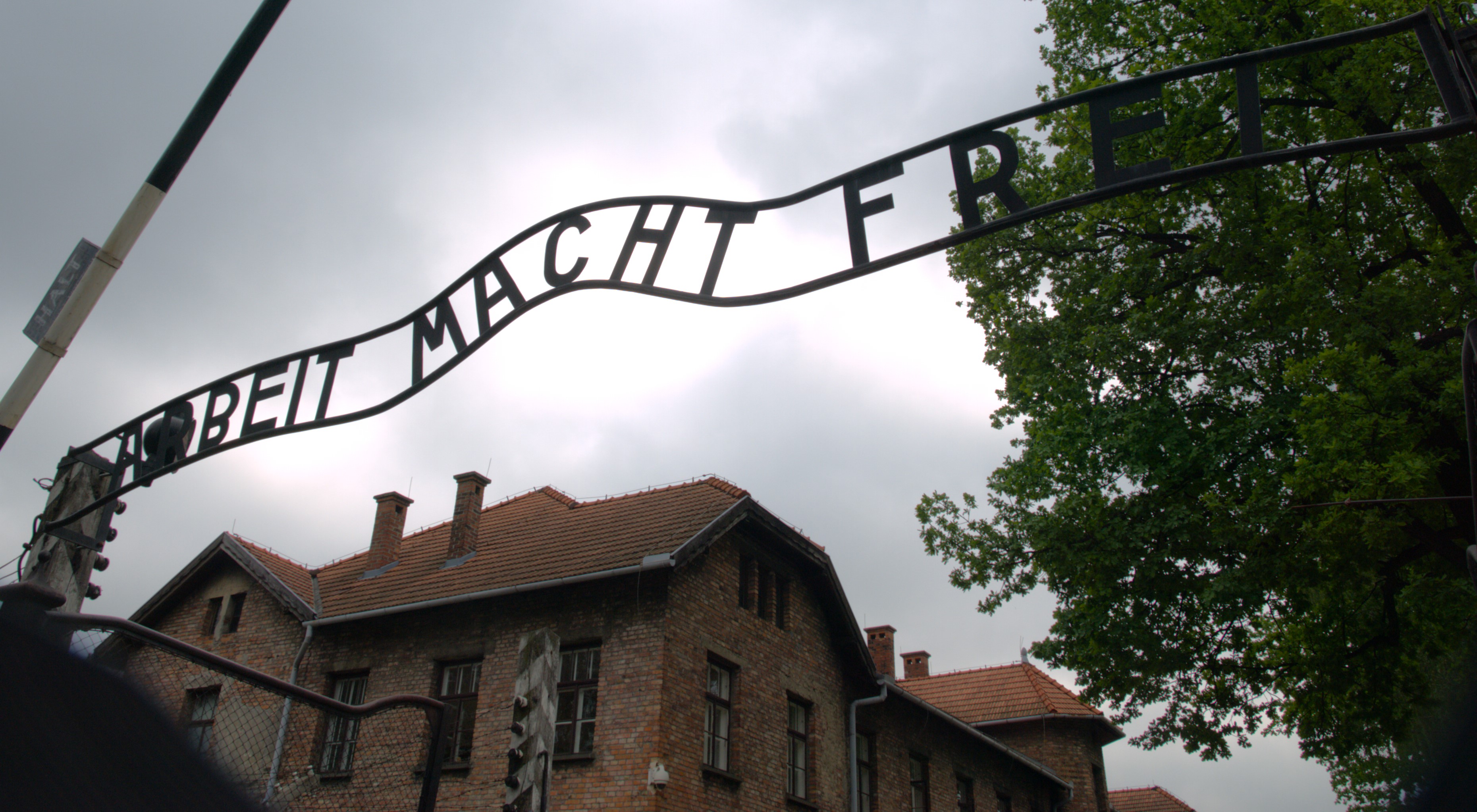
I suppose the sun does shine at Auschwitz. Of course it does. But, having been there on an entirely appropriate cold, grey day, it's hard to imagine it in the sunshine, the red bricks glowing warmly, 'Arbeit Macht Frei' silhouetted against a blue sky.
I was struck, though, by how neat and tidy it was, by the row of young poplar trees in front of the buildings, how well-maintained it all seemed. Perhaps it's a mark of respect by the Germans, who to their credit keep this shameful part of their history open to everyone, for free - or perhaps it was always like that, a kind of orderly balance to the nightmarish things that went on there. It's true that there was a kind of disconnect that went on, men doing hideous things and then going home to their wives and children, living normal family lives.
We marvel at that, but it's important to remember that it's not solely a German characteristic: it's what all people are capable of, and you don't have to look far inside any current newspaper to find proof of that. The world has never been so connected, so conscious of events, so comprehensively informed by affected individuals as well as commentators - and yet it's still clearly entirely possible for some groups to dismiss others as not just not like them, but not even human, worse than worthless.
So visiting Auschwitz, and Budapest's House of Terror, and Hoa Lo Prison in Hanoi, which I have, and so many other similar places in Cambodia, Africa, Russia and elsewhere, which I haven't, is necessary. Travel shouldn't just be about good times, it should always be about learning, and understanding, and remembering. That's why they say it broadens the mind - and, if nothing else, the Holocaust came about because of narrow, blinkered thinking.
Thursday, 27 November 2014
High and low
So, tomorrow I'm heading for Dubai in the sybaritic luxury of Business class on Emirates' A380 (for free, which will maybe mitigate somewhat the pain of having recently had to PAY for flights with them to Turkey next year, an eye-watering sum that was undercut three days later by $600 on a special offer from Singapore Airlines. Still hurting). On my last couple of trips to the UAE I had to go on a desert safari which included dune-busting in a 4WD, the last time leaving all us passengers sick as dogs from all the lurching and cornering, and totally unable to enjoy our "Arab-style buffet feast" - which, as it turned out, was no tragedy. So I've got out of it this time round and instead have paid (sigh) to do something much pleasanter and more peaceful: a ride over the dunes on an Arab horse, and then a sunset trek on a camel which will last 45 minutes and be much more fun than the scant three minutes you get as part of Arabian Adventures' desert safari.
Then it's on to Budapest, which I visited a couple of years ago on an Insight coach tour - beautiful city, no penance to return there. This time though I will be leaving along the river, on Uniworld's River Beatrice which will be my home for four nights as I sample the first part of their Danube cruise. I'm so happy to be returning to river cruising - quite my favourite mode of travel - though it is going to be cruel, making me leave after Vienna when everyone else will be continuing on to Passau in Germany. So I shall just have to make the most of my lovely cabin, the friendly staff, the great food, and all that continuous, 360-degree scenery. And you know what's going to make it even better? Christmas markets! I can taste the Glühwein already...
Sunday, 7 September 2014
With gratitude to the French
Thanks to the glories of Google, two model enthusiasts in Brittany have found me and told me about the diorama that one of them is making of the scene of the plane sitting in the shallow waters of the bay, with the three crew making good their escape. The modeller had had another project in mind until his friend told him about this event, which he knew about in full detail, because his grandmother was one of the primary helpers in hiding, moving and looking after the men. I knew her name too, because in the report Dad wrote as soon as he was liberated and returned to England in 1945, he names her, and clearly admires the spirit and bravery shown by all the women who helped them.
When the Germans caught the three airmen six weeks later in Nantes, where the Resistance had moved them, intending to get them to Spain and thence to England, the women were arrested too. They were taken to Ravensbruck concentration camp in northern Germany, which was unusual in being for women and children only. Over 130,000 people were sent there during the war, and only 15,000 to 32,000 survived. There were medical experiments, exterminations, starvation and disease - towards the end, 80 died every day. Knowing that, it's especially hard to read Dad's description of them when by chance he saw them in Angers as he was being loaded into a bus to be taken to Fresnes prison in Versailles and then, eventually, to Stalag Luft III:
Mme de St Laurent's grandson sent me a clipping from the local paper last year, reporting that a plaque was to be erected in the alleyway in St-Efflam that leads to the beach where Dad and his crew waded ashore to hide, initially, in the roof of a hut. And this week I received a photo taken recently of the plaque by a visiting Kiwi who knew the story, and came prepared with an Anzac poppy. It feels so right to see it, and to know that those courageous women have been remembered and honoured for their sacrifice. If it weren't for them, I wouldn't have a father. In fact, I wouldn't be here at all.
Saturday, 24 May 2014
Paradise lost
It was so sad to watch the TV news last night and see Paradise Lodge consumed by fire. It was hit by lightning yesterday morning and burned almost completely to the ground, despite the fire crews who came from nearby Glenorchy and from Queenstown (40 minutes away). All that's left of the main building are the chimney stacks and part of a wall. I stayed there just a few months ago.
It's such a shame, on many counts. It was built in 1883, which is pretty old for New Zealand. It had lots of local history. It had been rescued from neglect and sensitively renovated by a trust of local people, who poured much time, care and personal energy into it. It was full of period furniture and books and original paintings of the area done long ago by people visiting to study art (it was always a tourist operation). It was the high point of the Paradise Trail, cyclists spending two nights under its roof. And it was a beautiful building, cosy and welcoming, under its huge chestnut tree, with bantams and chicks scratching in its garden.
The initial reaction of the Paradise Trail people is that the Lodge will be rebuilt, as a replica, and things will continue as they did. I hope so. Apart from regretting that it was necessary, I wouldn't be that bothered about the building not being authentic, if it was well done, as it will be. There's plenty of precedent for that sort of thing: Europe is full of reconstructed medieval towns that were destroyed during the war. I'm thinking Frankfurt, Dresden, Warsaw, as examples. The people wanted their buildings back, so they replicated them and now it's hard to tell that they're not original. I don't see anything wrong or dishonest about that - it's a comfort, not a con. It's also become a huge economic boon: what tourists would come to see towns built in 1950s and 60s architecture?
There's no reason, given enough determination and, cough, insurance money, why Paradise Lodge can't one day be Paradise Regained. I hope so.
Tuesday, 28 January 2014
International Holocaust Memorial Day
Correctly speaking, this is the Memorial to the Murdered Jews of Europe, in Berlin, but everyone knows it as the Holocaust Memorial. It consists of 2711 concrete slabs of various heights, arranged in a grid pattern over an area of nearly five acres. It's an odd concept, not like any other sort of memorial I've visited, and some mindless ratbags even seemed to be playing hide and seek through it, but there's no doubting its serious intent. Huge and grey and sharp-edged and full of shadows - I think it works. Because, really, how else could you do it? The scale of the atrocity, and the horrific detail of it, are pretty much untranslatable into anything more graphic.
It's enough that Auschwitz, and the other death camps, are still there, open to everyone and un-whitewashed. Our Insight Vacations coach tour of Eastern Europe was WWII-centric and often very grim, but it was fascinating and educational and memorable, and I'm glad that I've done it. Especially Auschwitz: to walk through those buildings, lined with framed photos of prisoners, past the tangle of spectacles, the mounds of hair, the huge piles of shoes, all sizes, in the company of a guide whose grandfather survived Auschwitz, really focused the mind. The cells, firing range yard and gallows posts, the high electric fences, the extermination wing... and then the shower room, and the gas ovens with their clever mechanism for efficient transferral of corpse into flames: everyone should go there, and be reminded of what can happen.
Monday, 2 December 2013
The things you see when you haven't got your gun!
That was what my unreconstructed HOD back at Newent Community School said when he saw one of the ancillary staff heading off to the gym in her exercise gear, to a roar of laughter from the other men in the staffroom. Her name was Julie; I'm pleased to say it took me 3 days to remember his name was Bob. It was 1983 and male chauvinism was still rampant, especially amongst middle-aged, fat, bored English blokes like Bob: when you tut over how PC life has become, remember how uncomfortable it could be back then. But his comment came back to me the other day because I heard myself echo it with "The things you see when you haven't got your camera" - having just witnessed a duck flying right in front of me, quacking loudly, with another flapping behind it, the first bird's tail feathers clamped in its bill.
These days such sights are captured forever thanks to cell phone cameras, and if I had any pockets in my exercise clothes, I would have got that one too. Out walking is the only time I'm separated from my phone now: so different from my blasé attitude to my first little clockwork Nokia. Then, Nokia was #1 - now, it's stopped doing phones entirely. It was only when I met some Finns at Colleith Lodge in Tairua that I learned it was a Finnish company (that had previously made gumboots). That's the nice thing about staying in upper-end accommodation: you meet the other guests and often dine with them, which can be interesting and entertaining. That's what fabulous places like Treetops near Rotorua have in common with backpacker hostels, and it's a real plus.
Stay instead in a regular hotel, even top-range ones like the Fairmonts we recently enjoyed in Canada, or the Peninsula Hong Kong, or any other of the swanky places where I've been lucky to lay my head, and you never get to exchange a single word with the other guests. The Pen (as we old hands call it) makes a feature of it - we were checked in in our actual room, not even having to linger in public at the reception desk. And the really exclusive guests there helicopter onto the roof and go straight to their suite without having to slum it by walking through the lobby at all. Maybe that's important if you're a celebrity and tired of having the same conversation with everyone you meet: but for us ordinary people, whether travelling alone or as a couple, it's nice to have the chance to chat with different people from different places, to learn things, swap experiences, and hear new jokes.
You can also make observations, such as that Germans speaking English say 'actually' a lot as a kind of filler, giving them time to think of the word they want. Whereas English-speakers - speaking English of course: what else - say 'um'. And that's kind of satisfying, in terms of national stereotypes, don't you think?
Wednesday, 27 November 2013
Nineteen: it's a dangerous age
This was the front-page story in the Herald yesterday, about a 19 year-old German tourist who climbed Mt Ruapehu on his own, in light clothing and street shoes, not having told anyone about his plans. You can see where this is going. He fell, broke a leg, and was lucky, having dragged himself a bit back down the mountain, that some other climbers heard his cries of "SOS" and called the helicopter to rescue him. [Digression: SOS? How bizarre. Who would think to shout that? What's wrong with 'Help'? Even 'Hilfe' would have done the trick. SOS - that's just so technical. How German!] Having climbed Ruapehu myself, though not to the summit, I know just how steep and treacherous it is, and how rapidly the weather can change up there. He's a lucky young man who I hope has learned a lesson, and isn't tempted to feel smug. Not like this idiot:
Here we have another 19 year-old tourist, this time a backpacker from Alaska who got left behind by the Ghan in Port Augusta, chased it along the tracks, caught it when it slowed, and perched in a stairwell outside a locked, empty carriage for over two hours as the train raced through the Outback on a chilly winter's night. He was heard, eventually, the train did an emergency stop (spilling my glass of Bailey's as I sprawled out in my Platinum class suite) and he was brought inside suffering from early hypothermia. He was lucky not to have lost his grip and fallen to who knows what fate - as it was, he got off at Alice Springs and a few days later was being feted in Darwin for his exploits. I bet his parents were proud. (But well done, Territorian, on that deathless headline!)
By the way, coincidentally, when I climbed Ruapehu there was a German up there too, also unsuitably dressed - a journeyman carpenter from Frankfurt. But not 19, and sensible.
Saturday, 22 September 2012
Living in fragments
I've just finished watching the 1992 Merchant-Ivory movie of Howards End which reminded me how much I love EM Forster, and that I must re-read him - it's been years. So should you. Also, cast your eyes to the right, and there is the dedication from that novel: "Only connect", which I use in a very superficial manner, but the concept of which of course simply suffuses his story, about the buttoned-up Wilcoxes and the intense Schlegels, about the prose and the passion, and unconnected arches.
The 21 arches in my photo are beautifully connected, and curved: McAlpine's Glenfinnan Viaduct in Scotland, and that's the Jacobite crossing it, which stood in for the Hogwarts Express in the Harry Potter movies. There were a lot of lovely steam trains in the Forster movie, and echoing railway stations - such a gift to directors, almost a cliché, they're such romantic places, as full of meetings and partings as airports, but so much more atmospheric.
Having written 26 stories and 28 blog entries (not this one: Air France) since getting back from Europe in June, I've got just two more to do next week to complete my commissions and clear the decks ready for the next lot of travel - and those two are about travelling around Europe by train. I didn't have the time to do a proper expedition, but on one day going from Dijon to Surrey I took 7 separate trains; and on another I spent the entire day on the train from Berlin to Budapest, not reading but looking out of the window and watching the day pass in real time as Germany and the Czech Republic and Hungary went by outside. Some people might have found it boring, but I loved the feeling of being both unconnected, or unplugged, in the sense of having nothing to do but sit and gaze and daydream, as well as connected to the journey in a way you never are in the limbo of an aircraft. Though, I have to say, modern trains, while faster and more comfortable, have lost a lot of their romance after years of 'improvements'.
Wednesday, 12 September 2012
US 9/11 = NZ 12/09
Today it's bright and sunny, sharp and clear, with a cold wind blowing up from the south where there's been a big dump of snow. It was a sunny spring day like this 11 years ago when I strolled into work across the road, all unknowing, to be met by shocked faces; and it was sunny and cold and spring just like this when I went to New York five years later, for the first time.
It was so exciting to be there: so strange and yet so familiar; so scary by reputation and yet in actuality so friendly and safe. I had such a great time exploring Manhattan mostly on my own, trusting to serendipity and the kindness of strangers and being repaid in spades: nice locals helping me out with directions ("I want to you enjoy my city") and sorting me out on the subway ("I never usually get to help people"); scoring a cancellation ticket for Spamalot; happening across CSI:NY being filmed, complete with dead mermaid on the jetty underneath Brooklyn Bridge heartlessly kept wet in the icy wind by someone with a water spray; the friendly FDNY guy who let me try on his helmet and amazingly heavy jacket; the choir and orchestra rehearsal of Bach's St John Passion in a church with perfect acoustics.
I was dismayed by the expense and uncertainty of tipping, and irritated by all the bossy notices. Everything else, though, was just as it should have been: the continuous whistles and sirens, the policeman writing up his notes on top of his imperturbable horse in Times Square, the five ear-pops on the way up the Empire State, the yellow cabs and absurdly long stretch limos, the ice-skaters at the Rockefeller Centre, the incidental foot-massage I got from the shoe-shine guy, the young man in a beanie doing tai chi in Central Park... I even went to see the Blue Man Group [Homer Simpson: "They're a total rip-off of the Smurfs!"] which was lots of fun; and today's tenuous connection, since I'm writing about Berlin, where they were also playing.
Friday, 24 August 2012
Investigative journalist required
The plot thickens. When I did some sums, gasped, and emailed Chris in Belgium that the buyer who beat him to the photo had within an hour spent 1776 euros in all on photos from this vendor, he emailed back saying, "If it was Sudek13, then you've no chance."
Sudek13, it's easy to find by googling, is an immensely rich Canadian with a team who trawl eBay for militaria, artworks, models and who knows what else, always using a sniper to swoop in at the last second to nab the item. Nothing wrong with sniping, of course, I've done it myself - what's got them all chattering out there though is that he has so much money to throw at the bids that no-one else has a chance - and then, having bought the goods, they disappear.
Chris, after some auction battles with Sudek13, had a man show up at his door with pocketfuls of cash offering to buy his entire collection. This same minion, he told me, when Chris came across him later, had deserted Sudek13, having discovered that he is buying up all this stuff in some sort of tax-avoidance deal with the Canadian government, which is storing all these items - of great public interest, obviously - away in some facility where no-one has access to them.
It's all very interesting, curious and a bit sinister, and my having got to this point feels like the opening scenes of a Matt Damon thriller - or at least a long piece in the Washington Post. Where are Woodward and Bernstein when you need them?
(But at least Chris has located another photo of the plane, bought by someone else who may be less reclusive. So the story continues...)
Thursday, 23 August 2012
eBay goom
At the risk of overdoing the subject of my father's wartime exploits, here is another photo of his ditched plane, clearly showing the MK-U call sign - obviously taken before the others, before the Germans towed it out of the water. It's become a bit of a quest, not to say obsession, to track down that other photo to see if I can get permission to publish it in North & South. Who liked my story so much, by the way, that they asked if I could make it a bit longer. How often does that happen?
I do so love that this project has tuned into something so international. This latest photo has been sent to me from Daniel in France, who's compiling the ABSA website to record all that he can about every WW2 plane crash in Brittany during the war - aircraft details, crew, their personal details, information from people on the ground, photos... It's rather a heart-warming thing that he's doing, preserving the stories so that they're not lost, and nor are the memories of the people involved. Then there's Jonathan in England, who's helping him locate the descendants of some of the crews, and who is fortunately much cleverer on the internet than I am.
On my own, blundering around eBay, I located Christiaan in Belgium who had tried to buy the photos, but was outbid in the closing seconds by another person whose details he not unnaturally couldn't remember. I settled in to plough even further through the German vendor's old listings, looking for a description that sounded right in amongst all the photos, medals, helmets and other military miscellany that had been bought by people leaving feedback in German, French, Spanish, English and goodness knows what other languages. Meantime, Jonathan located the item number on a forum - and how brilliant was that - which allowed me to go almost straight to the buyer. Who's in Canada. Only where Dad was born, and where he had a layover en route to Europe in 1941, in Nova Scotia - which is somewhere I've been hankering to go for a while now, mainly because I don't know (or thought I didn't till I got into researching Dad's story) anyone who's been there. Sigh. Again with the coincidences. Fingers crossed now that he gets in touch.
Subscribe to:
Posts (Atom)