Monday, 17 May 2010

Before and after - and here, not away

I read once in a chicken care book written by some unreconstructed male that hens, like all the ladies, make a point of getting a new coat for the winter - and that's certainly what my six have been doing over the last month or more. The two old girls got theirs sorted early on, but the teenagers have left it to the last minute, and must be finding the nights pretty nippy with all that bare skin. On the other hand, at least they shouldn't be bothered by the mozzies now.

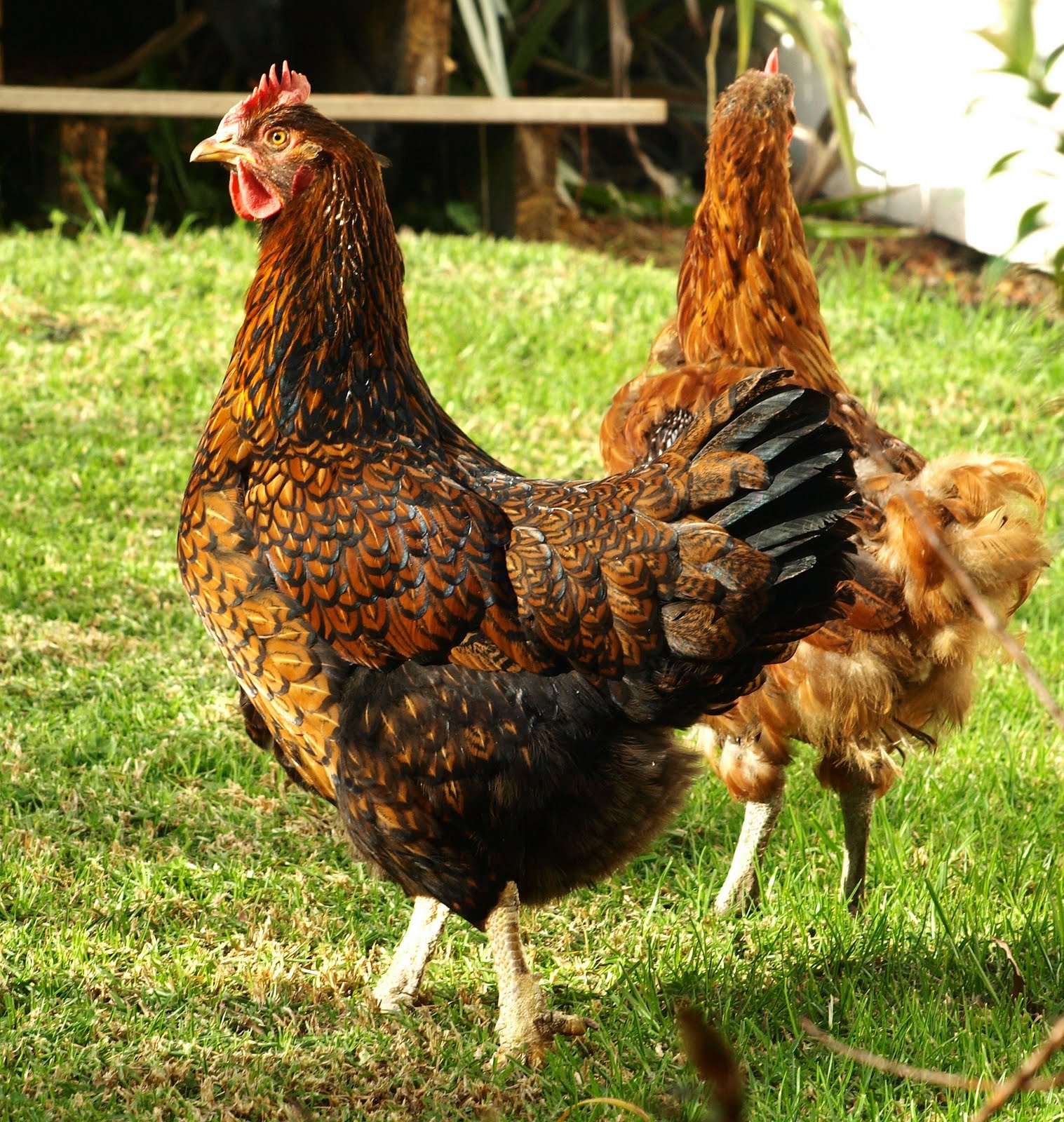
I don't think I've ever had hens that have done the job so thoroughly as these ones - they look oven-ready, they've lost so many feathers, and the new ones are poking through in a very uncomfortable-looking manner. They're rather bothered by the loss of their flight feathers, too, and swear like troopers when they find they have to run the long way around when I appear at the top gate, instead of flapping up the short-cut over the compost bin.

One of them, the cool, organised one, has got her new outfit finished already, and looks absolutely splendid when the low sun catches her feathers and brings out the beautiful coloration. The Barnevelders may not match up to the Brown Shavers when it comes to egg production, but for looks they knock them into a cocked hat.

Mind you, when they're moulting, none of them lay any eggs at all, so I had to buy some the other day at the supermarket. I should have waited to get them at Matakana, where I'm sure 'free range' means exactly that - not like the huge flocks of birds I saw from the train in Cambridgeshire which were, granted, ranging freely, but in big barren fields with not a skerrick of green to be seen, poor things. There's nothing a chicken likes better than a variety of fresh greenery to peck at - except for meat, in which case it's velociraptors all over again.
Sunday, 16 May 2010

Oh, boy

Up to Matakana yesterday, an hour's drive through green and orange countryside on a blue-sky day (apart from the sudden squall around lunchtime that dragged the temperature right down - but at least we were spared the nearby mini-tornado).

The Saturday market there is a real institution: slow food from local producers at fair prices. We went to have our knives sharpened by the ex-pat Irishman who prides himself on a precision job: three separate grades of sandpaper, two different stones and four grinders, at the end of which he tests the blade by shaving the hairs on his forearm, which is presumably as smooth as a baby's bottom. It's a long process, made longer by his clearly having kissed the Blarney Stone back home, and an apparent inability to multi-task, so that the job comes to multiple halts as he chats about politics, life, and local gossip (the whitebait fritter lady was once exposed as using Chinese whitebait, shock, horror!) Still, it means he fits in well with the slow food philosophy, and he certainly gets the knives lethally sharp. "Keep some Bandaids handy in the kitchen," he warns every time.

We weren't in any hurry anyway, as we were going to the movies. Matakana's cinemas are a joy both to behold and to sit in - but the greater joy this time was watching Taika Waititi's Boy which was wonderful: funny and sad, deep and powerful, but with a light touch. Beautifully done - I fully expect to be seeing this movie in random bits for years to come in media studies classes at school. And I'll count myself lucky.

Thursday, 13 May 2010

At night the wondrous glory...

I've just been persuaded to go to Australia again, next month. To the bit I think I really like best: the Red Centre, where the Outback truly is red, the sky is cobalt blue, and there's a shimmer along the edges where the two meet. It's harsh and dangerous and beautiful, and nothing like the wussy, grassy, soft post-rainfall Outback I saw in Queensland a couple of weeks ago.

There will be camping, as there was last time I was there, and hopefully in a proper swag again under the stars. Well, I say proper swag: it's a pretty cushy modern equivalent, with an actual mattress inside the canvas, and sheets, and a duvet and a pillow - so it's very comfortable, but I wouldn't like to have to carry it on my back as the old swaggies did.

We went to the Waltzing Matilda Centre in Winton while we were in Queensland: it's a simple song, just the eight little verses, with lots of repetition, yet the centre is really extensive, and you could easily spend a couple of hours there. First there's the ghostly swagman in the billabong, giving the background and telling the story, explaining - quite movingly - the song's place in popular culture; then there's a gallery of personal stories of hard Outback life and the origins of the song (there's a whiff of scandal about how Banjo Patterson came across the tune), a nifty hologram show, a theatre with video of academic interpretations, a gallery of original Outback art, an excellent museum, a shop and, of course, the Coolibah Cafe. And how many times did I hear the song as I wandered through? Goodness knows - but no-one could hear John Williamson's 1999 rendition at the Rugby World Cup in Stadium Australia with 107,000 backing vocalists and not feel a tingle.

I saw him last year, you know, at Wilpena Pound. He sang in the dining room at the resort, and forgot some of the words - but not to Waltzing Matilda.

Wednesday, 12 May 2010

Rain, rain

At last it's raining. It's been dry for so long that there are cracks in the lawn and even the weeds have stopped growing. But now it's raining, and I have hope that earth will fluff up around the piles that the house sits on and hold them tight and straight again, so that the cracks in the ceiling will close up and our doorways will revert to right-angles and the doors will open and shut as doors are meant to, ie without a muscle-wrenching wrestling and struggling and a sudden frightening shudder that surely one day will make all the glass shatter.

From 1895 to 1902 Australia suffered from a ruinously severe drought across much of the country. The people were so desperate that in Queensland they listened seriously to Clement Wragge, who had made a name for himself as a meteorologist. He reckoned that Albert Stiger's Vortex cannons, invented in Austria to disperse - successfully - hail clouds that threatened orchards and vineyards, would work as well when fired into the atmosphere to make clouds drop their moisture as rain onto the parched earth.

In September 1902 the Charleville Municipal Council funded the purchase of 13 four-metre high cannons which were deployed around the area with a spectacular lack of success, some of them actually disintegrating when fired but fortunately injuring no-one. It wasn't Wragge's finest hour, and despite having earned some kudos for establishing weather stations across Australia, making the first long-range weather forecasts, and inventing the naming of cyclones (after politicians, on the grounds that they were also natural disasters), he's mostly remembered as a larrikin.

Which isn't to say he's been dishonoured: the Aussies have a soft spot for larrikins - people who defy convention and authority, take risks, push boundaries. How else do you explain the Ned Kelly phenomenon?

The drought, by the way, broke all by itself a couple of months later.

Monday, 10 May 2010

A nod to nature

Out on my walk this morning, I saw a big old macrocarpa (Monterey cypress) being cut down. They grow like weeds here and are very common, but still, it was a huge tree and old, and apart from blocking the light of the house tucked behind it, harmless. Unlike the carnivorous pisonia trees on Lady Elliot Island.

These have bird-attracting fruits that are so sticky that the birds get caught on the tree, flail about getting stuck even more, fall to the ground, die, rot and dissolve into the soil, thus feeding the tree. Presumably the original adaptation was simply for the seeds to stick to the birds' feathers for dispersal - but hey, this works too.

The main species it catches are white-capped noddies, which when we were there in April numbered about 30,000 - impressive, except that at the height of the breeding season, there are ten times that number on the island. Hard to imagine where they'd all roost - as it was, I frequently felt as though I was walking through a scene from Hitchcock's 'The Birds'.

And the name? Like all seabirds, they drink seawater, and to rid their bodies of the salt, they continually nod their heads so it runs out of their nostrils. In-body desalination plant: clever. Carnivorous tree: slightly scary. Nature is a constant marvel, eh.

Sunday, 9 May 2010

Go fish

So, underwater cameras. A brilliant idea, in theory - although unnervingly unnatural in execution, taking what looks exactly like a regular camera and dunking it in sea-water. The advertising shows happy people in the water taking sparklingly clear shots of brightly-coloured fish flitting past fluorescent corals. Real life - and I apologise if this disillusions you - is somewhat less successful in my experience, hingeing as it does on two inadequacies, one mine and the other the camera's.

Mine first: poor eyesight caused by an unusual combination of inherited astigmatism and myopia ("Goodness! What an ill-matched pair!" my first optician said in astonishment) exacerbated by age-related visual deterioration. I did my best, getting fitted for disposable contact lenses that I could wear with a mask, and plumped for distance vision so that I could spot the fish in the first place, trusting to the camera to sort out the focus for me.

But I reckoned without the camera's own inadequacy: digital delay, so that the time lost in conveying the image to the screen and then, after clicking the shutter, to the memory card, is hopelessly out of sync with the speed of fish zipping through the water. (There was also the small matter that my long-distance eyes couldn't see clearly if I'd aimed the camera at the fish in the first place.)

So this is what happened when I met a pretty little wrasse in the lagoon at Lady Elliot Island:

Oops!

Oh dear...

Ummm...

Ooo!

Nearly....

Gotcha! Ah, actually, no... Spit.

But it was lots of fun trying, the time just flew by, and I was - reluctantly - last out of the water.

Saturday, 8 May 2010

Bon appetit

Weka have been in the news recently. The Department of Conservation is planning a mass extermination of these cheeky little flightless native birds on two West Coast islands to protect the rare geckos, skinks and, yes, leeches that also live there. Apparently over the last 100 years the weka have become very inbred and, according to a bearded, weathered man who's familiar with them, and looks a tough old bird himself, he's seen some with eyes that are "frightening".
I often saw these birds in my youth, when I was tramping or away with my mother rock-hounding as in this photo when we were on the Coast to do a spot of gold-panning. (Yes, I found some colour, which I carefully strained into a handkerchief - and later blew my nose on.) They were always poking into things, playful and curious like lowland keas, and we filmed one once trying to abscond with a bright yellow towelling hat that was too big for the weka, which was the size of a small chicken, to lift off the ground, so it kept stepping on it and tripping over. How we laughed.

But it appears they're less common these days, and a man near Christchurch has been thinking laterally and wants to breed them for the table, on the premise that if people can make money from something, it will never be allowed to die out. Cynical, but true, no doubt.

He claims they taste (surprise!) better than chicken, and it made me think about all the less regular foods I've eaten. It's not a startling list compared to some people's, I'm sure: emu, ostrich, kangaroo, crocodile and camel are pretty ordinary these days, and I can buy most of them at the supermarket. I could buy goat at the supermarket too: I recently ate it for the first time in the Cook Islands (not India). In the wilds of Tasmania, I was embarrassed to find myself eating barbecued wallaby as a cute little baby one hopped past. In France and elsewhere (in Pagan, in Burma, at a back-street restaurant I was once asked, "You want meat? We have chicken or frog") I've had frogs' legs and snails, naturellement - the former ridiculous, nibbling bones like matchsticks (reminding me of Tom Hanks in 'Big' with the baby corn), the latter a - not unwelcome - let-down since all you can taste is the garlic butter they're prepared in.

In Maré, in New Caledonia's Loyalty Islands, I ate fruit bat and heartily regretted it: dark, gamey and rather tough; and also coconut crab, which looked unnervingly like a giant head louse, but tasted divine. And in Peru, of course, roast guinea pig, also regretted because it was chewy and unpleasant, and though in the restaurant in Cuzco it was presented jointed, I'd couldn't forget the cooked ones I'd already seen in Pisac: whole, shiny brown and looking unnervingly like a miniature Tyrannosaurus Rex. Yuk.

LinkWithin

Related Posts Plugin for WordPress, Blogger...