Showing posts sorted by relevance for query Antarctica. Sort by date Show all posts

Sunday, 4 March 2018

Pining for the fiords (well, glaciers)

Yes, agreed, this is a First World Problem, no argument. It's a privilege to even think about describing it, I realise that. OK?

So. On my recent Silversea cruise to the Antarctic (cue a volley of clicks on the x above) the term 'bucket list' was bandied around a lot. A lot. So many people I spoke to on board were gleefully anticipating ticking Antarctica off, having dreamed for ages of going there some day. And that is perfectly understandable and acceptable: it's a spectacular, beautiful, unique place, far away and hard to get to. It takes a lot of money and effort to go there - but quite apart from the delight of being there, and the memories (and thousands of photos) you carry away, there's the enjoyment of being able to bore people about your trip for the rest of your life. All worth a one-off major splurge, right? Absolutely.
Except, and here's the thing, there was a surprising number of people on board who had actually already been there. I truly was surprised. I'd thought Antarctica was the epitome of a been-there, done-that destination, for the reasons above. But, apparently, not. How rich would you have to be, I wondered, and/or how exhaustingly well-travelled, to be going somewhere like Antarctica for the second time?

[Side note: Silversea is a top-of-the-line cruise company, ie not cheap - this 18-day cruise started at NZ$30,000, with many unavoidable add-ons - but such is the ambience on board that you really wouldn't be able to pick the insanely rich from those who had saved up for years to buy their ticket. Or, indeed (so I hoped, anyway) those who had swanned there on a freebie.]
This, though, was all before we got very far into the cruise. Once we'd hit (metaphorically) South Georgia, and definitely once we got to the Antarctic Peninsula, it all became clear. This place is absolutely, honestly and truly, so thoroughly spectacular, beautiful, unique and SPECIAL that I understood why people went to all that expense and trouble to come back again. More than understood: agreed with them. Now I want to return to Antarctica too. I want to see again those icebergs, watch, hear and even smell all those adorable penguins, hear the clink and fizz of ice in the water on a rocky beach, and know that I am once again on the coldest, driest, highest and most stunning continent on the planet.

You listening, Silversea? (Or anyone else, come to that.)

Monday, 31 December 2018

And another one bites the dust

So that's 2018 over and done with. Yet another one that most people are glad to see the back of, for many good reasons, even though at least we lost fewer big names than recently - and, thank goodness, David Attenborough is still with us. 

Travel-wise, the year started brilliantly for me - but that did have its downside:


Glamorous scenery in Antarctica by Pamela Wade


Gentoo 

The best day of 2018 for me was January 1. That did, inevitably, mean it was downhill for the rest of the year – but it was worth it to have had that one perfect, exciting, glorious, beautiful day. I was on a Silversea cruise to Antarctica and this was our last full day before heading back towards Ushuaia.
We began by cruising into Neko Harbour on the Antarctic Peninsula for a hike through knee-deep snow up to a view across to a crevasse-fissured glacier that calved with a low rumble as we watched it fall in slo-mo into the turquoise sea. Gentoo penguins provided comic relief in their rookery – waddling, squabbling and stealing pebbles from each other's nests. The Silver Explorer glided as we ate lunch on the deck, interrupted by an encounter with a pod of orcas hunting, a long-awaited first for me.
We arrived at magnificently spectacular Cuverville Island for another hike to the summit or, my choice, chilling out in the sunshine on the stony beach watching penguins clowning on dazzling icebergs: blue, white, striped, smooth, textured and sculpted, some draped with crab-eater seals. Later, the afternoon's lectures were interrupted by the captain's announcement about a pod of humpback whales bubble-net feeding, and we watched, fascinated, as he circled around them, the crew escorting us through their quarters for a lower, closer view.
That night butler Ivy served us dinner as we watched March of the Penguins in our suite, periodically pausing it to step outside on to our veranda to admire the icebergs, glaciers, mountains and deep blue sea, in the golden light of a slowly-setting sun. We drank Champagne. Nothing else would do.
- Sunday Star-Times 23/12/18
That's not to say there wasn't more good stuff to come, just not quite as uniquely, specially, fabulously spectacular. The sea seemed to be a common theme. I got to Iceland! Yay. And that was deeply satisfying, as well as fascinating. I also, having been to Antarctica, got up into the Arctic Circle, to North Cape on a Silversea Norway cruise. And that was lovely too, though it wasn't smooth sailing, either literally or figuratively (purely weather-related, not Silversea's fault).
Antarctica, the Arctic, Iceland, Denmark, Norway and the UK - that's not bad going, but I would have liked more. I had to turn down Denver, and Burma/Singapore/Indonesia; and didn't pursue as many other exotic destinations as I have previously, for boring domestic reasons. I did, on the other hand, see plenty of New Zealand: sea to mountains, islands and interiors, by boat, train, bus, bike, helicopter, horse, kayak, zipline and on foot. 
One of the things we Kiwis do like to boast about (in our signature, laid-back, yeah-nah way) is that our country is marvellously diverse, scenically (actually also population-wise too these days: we have over 200 ethnic groups represented here). We've got pretty much every sort of scenery you can name, except for the Outback, and it's all packed in close, conveniently accessible. So I saw a steaming volcano, turquoise sea, snowy mountains, deep gorges, sandy beaches, green farmland, forest and cities. I saw lots of birds both winged and flightless, some dolphins, a couple of deer and, naturally, sheep (but not as many as people think. Especially the Aussies, who loudly assume we Kiwis enjoy unhealthy ovine relationships).
So that's pretty good going, really. I shouldn't complain about having missed out on some things. There's always next year...


Tuesday, 7 July 2020

Waddling down memory lane

I accept that it's inconsistent to be snarking about it being so cold today at the same time as wishing I was back in Antarctica, but I answer to no-one here, it's my blog so suck it up. (Sorry, made crabby by internet dropping out, leaving me unable to snap back at some self-important PR man throwing doubt on my having been somewhere I'd just written about because of a minor error that wasn't actually my fault.) (Also, sad because today I should be in Reykjavik about to begin a cruise tomorrow with Seabourn.)
Let's start again. I've been writing today about a visit to Kelly Tarlton's Aquarium here in Auckland. It has been in existence since 1985 and of course I've been several times before, but it was my first experience there getting up close with penguins. Regular 😀 readers will know that I have actually been up close with many, many penguins: in South Georgia and Antarctica, back at Christmastime in 2017.
I had the huge pleasure then, thanks to Silversea, of getting remarkably close to about eleven different species of penguins, in colonies tens of thousands of pairs strong. And boy! The pong sure was strong. It was very noisy too - but I loved it, every moment, watching the birds going about their business, being curious and funny and cute and beautiful, and it was the highlight of a cruise that was already the highlight of all the trips I've done.
So it was just lovely to get a little taste of that again, thanks to Kelly Tarlton's. They have 78 penguins, currently, King and Gentoo, a few of them an amazing 32 years old, survivors from the first birds to arrive here, from San Diego and Edinburgh. Of course I was a bit worried about their mental health, being confined to a space indoors, underground (the aquarium is built inside former sewage tanks). My guides were predictably, but apparently genuinely, reassuring that the birds don't miss the challenges of hunting food, evading orcas and leopard seals, hunkering down through appalling weather, and covering long distances doing most of that. They reckoned that being sociable was much more their style, and they spend their days happily doing exactly that - plus preening, pooing and napping.
I got all togged up backstage in winter gear and gumboots, and went out into the penguin enclosure, which is kept at -2 degrees, with carefully controlled lighting to mimic Antarctic conditions, seasons and times of day. As soon as the door was opened, some curious Gentoo penguins pushed in to inspect me, and all the time (20 minutes) I was in there, there were penguins getting very personal, in my face and pecking at my clothes.
The same thing had happened in Antarctica - no-one told the penguins about the 5-metre rule, and the chicks especially were bored waiting for their parents to return with a feed, and happy to find a diversion - but at Kelly Tarlton's I got super-close to them and was able to inspect and admire the gloriously subtle shading of the King penguins' golden feathers. Ten thousand feathers, they each have, apparently - makes keeping the ice clean at moulting time a real challenge. And that's on top (literally) of the poo that gets hosed off every morning before fresh snow is sprayed in. We were there just an hour after the mucking out and already there were yellow stains everywhere.

Penguin keeper Kristen brought in a squashy ball for them to play with, and they did enjoy it - there was inter-species competition for it, to the fascination of the two downy King penguin chicks. Playing ball with penguins - definitely up there on the travel skite list.
Oh, and KT's also rehabilitates injured turtles, before returning them to the wild. Their latest patient is Taka, an East Pacific green turtle that turned up on Takapuna beach, cold and hungry, and way off course from the Galapagos where it would normally hang out. *cough* I've been there, of course, and seen turtles. Maybe even a relation?

Saturday, 3 December 2022

No need to pike on Viking

My last overseas trip, way, way back in early 2020, was to LA for a big announcement by Viking about their expansion into exploration ships, to offer cruises in both the Arctic and Antarctic. It was a very professional and generous presentation, chairman Tor Hagen was personable and likeable, and I doubt there was even one spoilt and fussy travel journalist there who wasn’t won over, and itching for a freebie on the Polaris or Octantis. Now, though? Maybe less so.

It’s truly horrible, to imagine what it was like to be that poor woman, hunkered down in her comfortable cabin on the Viking Polaris, grimly enduring the notorious Drake Passage crossing. Perhaps she was trying to distract herself by remembering all the glories of Antarctica she had just seen, or by thinking of all the skite-points she was currently accumulating - and then a wave crashed through her window, showering her in jagged glass shards, and that was that. Awful.

Regular 😃 readers will recall that I have done that Antarctica cruise, with Silversea. Whenever I'm asked what my best trip has been as a travel writer, I always nominate that one, despite enviably strong competition. There's simply no beating Antarctica's spectacular and super-special scenery and wildlife, the cruise itself (sorry, Viking) was Silversea-gorgeous - and, topping off 18 days of fabulousness, on our crossing back to Ushaia, after universally increasing nervousness amongst all the passengers guests, we were blessed with the wonderful gift of Drake Lake. 

Incidentally, this is my third post, I think, about Viking line disasters - one per cruise type. There was the collision of a river cruiser with a sight-seeing boat on the Danube, an engine failure in the North Sea, and now this. It's just maths, though - it's one of the bigger cruise lines in the world, with two explorer vessels, ten ocean cruisers and around 80 river cruisers. Don't be put off.

Thursday, 10 March 2022

Shackleton, yes - but also Worsley


It's lovely to be distracted from all the horrible world news by the discovery in Antarctica, 3000m underneath the increasingly solid surface of the Weddell Sea, of the amazingly well-preserved wreck of the Endurance. It sank in 1915, on an ill-judged voyage towards a crossing of the continent by Ernest Shackleton - he was strongly advised not to go, because winter had started early that year, but he was stubborn and went anyway, with his crew of 27 men, 69 dogs and one cat.

The discovery was announced on the 100th anniversary of Shackleton's funeral, in South Georgia, where he had gone again to attempt another Antarctic expedition, his fourth. He died in Grytviken of a second heart attack, the first having happened in Rio de Janeiro in Brazil en route to South Georgia - which he had brushed aside. Antarctica does that to you, you know - gets under your skin, draws you back, won't let go.

I'd go there again like a shot, offered the chance. It's unique, stunningly beautiful, and pitilessly inhospitable. On my Silversea cruise there, despite it being so expensive (*cough* to regular punters, not freebie-grabbing travel writers like me), several of the passengers guests had already been there at least once.

We visited Shackleton's grave there, and toasted 'The Boss' with a glass of champagne; and later visited dauntingly barren and rocky Elephant Island, where his crew had clung for four and a half unimaginably brutal months while awaiting rescue. That they were indeed all saved is due in huge part to the comparatively-unsung hero Frank Worsley - of Akaroa, NZ - who managed to navigate their little lifeboat in almost impossible conditions over 1300 stormy kilometres to South Georgia, to summon a ship for rescue. 

It's also thanks to Worsley's excellent mapping skills that the discoverers of the Endurance knew to look in pretty much the right place for the wreck. And, another Kiwi connection, one of the photography team who took these amazing underwater images of the ship is James Blake, son of Sir Peter, famous sailor, who was killed by pirates while on an expedition up the Amazon. In Brazil.


PS While writing this entry, a Silversea email popped into my inbox about - you guessed it - expedition cruises to polar regions, focussing on a giant petrel feeding frenzy in South Georgia and Zodiac explorations in Antarctica. Connections, people.

Sunday, 14 July 2019

Blatantly, and - ideally - chillingly, entitled

I like to think that my stories are pretty easy reading, and I feel particularly comfortable about being able to write an opening that sucks the reader in, but - titles? Mine just suck, full stop. I find it really hard to write something apt and catchy, frequently succumbing to the nudge, nudge, wink, wink of alliteration, and they rarely make it past the subbing process. Usually the editor, much more practised at such things than I am, comes up with something heaps catchier. But not today, for my Viking Sun story in the Sunday Star-Times.

Sun - eclipse: yes, I see that of course.  But even though It's obvious and pedestrian and absolutely the sort of thing that I might eventually have come up with myself, all inspiration sapped by producing the story itself (my only possible excuse), I would never have written it - because it's just not true. One full day on a mid-level ship sailing between Auckland and Wellington? Yes, it was nice, and they did everything properly, and I didn't write anything I wouldn't stand by, but... "hard to eclipse"? Yeah, nah.


Sorry, Viking, but I've sailed with Silversea, to Alaska, to Montreal, to North Cape,  to Antarctica! All those destinations are what I call properly hard to eclipse - so hard, in the case of Antarctica, that it has actually kind of sapped my enthusiasm for any subsequent cruising. You can keep your Mediterranean, your Pacific Islands, even your Caribbean. The only thing that would really er, float my boat these days is deep Arctic - Svalbard, Iceland, Greenland, northern Canada. And I would want to do it on a smaller ship even than Viking Sun's 980 passengers. Half that is the maximum, thanks, preferably even less. Not fussed about fancy restaurants, big shows, pillow menus, all that - just a bit higher standard of living than I have at home will do nicely, plus cold and spectacular scenery, please. 


And *cough* for free, natch. Because I've just sold my SEVENTH Silversea Antarctica story to a fifth publication/website, bringing the total readership/coverage up to around 2.5 million. I think that's a decent return, don't you, Silversea/Seabourn/Windstar/National Geographic?

Sunday, 8 April 2018

Not picking up a penguin

This is something they don't warn you about, when you go to Antarctica: that you get so used to seeing seals lying around just about everywhere, that when you're back home going about your business and catch a glimpse through the doorway of the bag of mulch and pair of Crocs and gloves you yourself left on the deck outside, your first thought is "Oh! Elephant seal!"
Of course, it probably didn't help that I've just been writing about that fabulous Silversea cruise yet again, and poring over the photos. The focus this time is South Georgia, that previously-unknown (to me) island group that turned out to be in serious contention with the Antarctic Peninsula itself as star of the whole expedition. My angle is the Kiwi connection - of course, the awesome Frank Worsley, of Akaroa, captain of Shackleton's Endurance, who managed to aim that little lifeboat unerringly from Elephant Island 1300km towards South Georgia, despite getting a navigation sighting only four times in the 16 days it took, so horrendous were the conditions across Drake Passage. 
And he was one of the three who then lit out straight away across the mountains and glaciers to the nearest help at the Stromness whaling station on the other side of the island - 36 hours of continuous effort. And their equipment! No map, heavy wool and oilskin clothing, and screws fitted to the soles of their shoes for better grip on the ice (didn't work).
But there was another Kiwi element to my South Georgia visit, which has two current connections: terriers Wai, Will and Ahu (and their handlers Miriam and Jane), who were there when I was, on Christmas Day, carrying out the final phase of a seven-year pest eradication programme, the biggest ever in the world. They have been busily scouring the main island since late December, sniffing for rats and hopefully not finding any, allowing the South Georgia Heritage Trust to announce soon, this month, that the programme has been a success, and all the rats are gone.
That will be a huge boon to all those ground-nesting birds: lots of seabirds, of course, as well as Antarctica's only songbird, the pipit (which I heard chirping tunefully away) and the pintail duck, which I also saw. 
And, naturally, penguins: King, Gentoo, Macaroni and chinstrap, all of which I saw in their thousands (and heard, and smelt). Fabulous birds. The King is the second-biggest - and this afternoon I got hands-on with the smallest species, the little blue penguin, native here, and which has had a terrible time this summer. So many deaths! 
I've found three myself this year already, washed up on the beach: starved to death, mostly, because of too-warm sea conditions, water made murky by storms, and over-fishing. Very sad. So I went to see what the bird rescue lady does with the five she has currently in her care. In a nutshell, it's lavish oodles of time, care and a not inconsiderable amount of money on them. For no reward, monetary or, it has to be said, avian. Ungrateful lot. I tell you from personal experience, those penguins may indeed be little, but they will bite the hand that feeds them - hard!

Thursday, 4 January 2018

Silver Explorer, Day 18 - Sorry

With thanks to Silversea for this hosted cruise
The Captain warned yesterday of a gale overnight, and no-one was quite sure if it was a joke or not, because that’s how he rolls – but in fact so did the waves during what was almost the dark (further south, the sun has been setting around 11pm and rising again before 3am, and the bit in between has never even approached what you might call dark).

This morning though it was calm again, and there ahead of us, too rapidly getting larger, was land: Tierra del Fuego, and the end of our voyage. Everyone is sad about it. It really has been so special, and though some people (mainly the ones who got soaked in the downpour in Stanley while I was in the museum knowing nothing about it) would have liked a bit more sunshine, general opinion has it that we did well, seeing Antarctica in all of its moods. Well, most, anyway. I can cope without experiencing a blizzard.
When we got back to our cabins suites after breakfast, there were our suitcases laid out on the bed – a pretty brutal sort of hint. We had already received disembarkation instructions last night. There was a little note from our butler Ivy offering to do the packing. That’s an interesting concept and almost tempting, but I’m passing it by. Too many decisions that only I can make, really. And thank goodness for my expansion zips, which were the reason I bought this particular suitcase ages ago, and which it’s been ever since a mark of honour not to use. Silversea gives you a puffa jacket as well as an outer parka, both of them very well made, but they’re something else to make room for. Along with the two blouses I didn’t wear, tch.
We took a break to listen to Anthony Smith’s talk about the art of bronze casting – something apparently random but which he managed to link to everywhere we’ve been – Ushuaia, the Falklands, South Georgia and even Antarctica have had bronze busts or statues that we’ve seen. The one in South Georgia was actually by Anthony himself: a bust in the museum, of Ernest Shackleton (of course). It was actually fascinating, to be shown the many stages in the process of creating a bronze, and Anthony is clearly multi-talented.
We’ve been impressed by the depth of knowledge of all of the lecturers, and have particularly enjoyed the talks by Anthony, Luke and Cory, who know their stuff inside out and communicate it intelligently and accessibly. And then it was Denis’s turn, to play the full-length version of the video he’s been compiling and without a doubt going cross-eyed and without sleep during the last couple of days to complete. Of course he has the big lenses, multiple camera bodies, and even a drone – but the talent and expertise help, too. It’s fabulous, and a wonderful reminder of the places we’ve been, the things we’ve done, what we’ve seen.

And so that was pretty much it: there was the Captain's jolly auction of that lovely map (it's gone to Chicago, for US$1300); then some drinks in the Panorama Lounge before dinner, with chairs at a premium as groups of new friends made the most of the last chance to be together; followed by dinner ditto; and then the ritual putting out of the packed and labelled suitcases before bed, and setting the alarm for the last breakfast, and the eviction at 9am as the crew work like crazy to make things ready for the lucky new consignment of passengers guests, who have all those good things ahead of them while we trudge through the tedious bits of flying back home again, our adventure over.

Monday, 15 May 2023

Naturally superior

Jerked rudely awake at 3am last night this morning by an almighty double thunderclap, which was disappointingly not followed by the consolation of a lightning show, I lay for several wakeful hours afterwards reflecting on nature's unexpected gifts. These have been the unplanned and unplannable, totally chance weather and/or wildlife events that have happily elevated what was already a fun travel experience into something properly special.

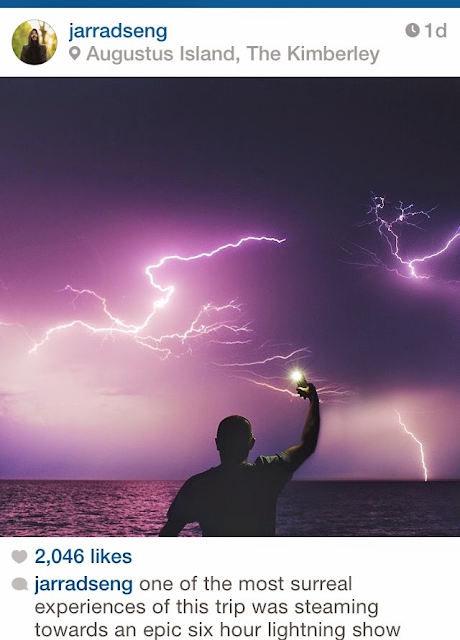
This morning's no-show lightning, for example, reminded me of the best display I've ever seen, or will ever see, that happened late one afternoon on a cruise along Western Australia's Kimberley coast. It was epic: six hours of non-stop forks, squiggles and flashes, as we gazed up from the deck first with our pre-dinner drinks, then eating dinner at sunset, then wallowing in the jacuzzi in the dark. No rain, no thunder, no sense of danger - just awe and amazement, and some personal frustration at not being able to capture the perfect shot. But we had Jarrad Seng on board, so that was ok.

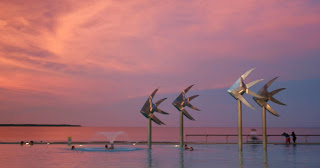
It was in northern Australia too that I saw an immense cloud of fruit bats flying overhead at sunset, as I sat beside the artificial esplanade lagoon in Cairns, enjoying the sight of big silver fish sculptures against the coloured sky. They came in their thousands, from their roosts somewhere inland, streaming out over the town centre towards a headland across the bay where the mangoes were ripe. Apparently it's a nightly occurrence, but for me it was an unexpected and very memorable gift. Which I wish I had a photo of.


Again, in Australia (I have been there a lot for
work), I was on a cattle drive through the Outback when, in the middle of the night, a dust storm swept through the camp. The walls of my tent billowed and shook, my ears popped, but I stayed hunkered down in my swag, tired enough from a day's riding after the cattle to get straight back to sleep. It was only when I emerged in the morning that I saw how lucky I'd been - several tents had been blown over, everything was covered in a film of fine red dust, and our cluster of tents was now cupped in the protective curve of the drive's big trucks, gallantly moved by staff during the storm to block the wind.


For travel writers, it's a gift when things go
wrong on a famil, though they usually don't because we're being hosted by professionals. But nature doesn't respect that - so when I did the iconic 3-day Milford Track down in Fiordland, and it rained and rained on day 1, the guide was very apologetic. I didn't mind, even though at one point the track was flooded thigh-high with freezing water that we had to wade through. It was great material - and besides, the downpour stopped just before we had to be helicoptered onwards, and thereafter the weather was brilliantly sunny.


Running aground on an uncharted rock in a bay
on a Rakiura Stewart Island cruise was a diversion, too. Yes, the scenery was gorgeous, our hike up to a viewpoint went ahead anyway, and the detour afterwards back to Oban for hull checks just gave us a different, and equally enjoyable, itinerary - but feeling the sudden shudder and stop, having to wait for the tide to float the ship off, and seeing scuba divers arrive to inspect underwater? Priceless.


Then, back in Australia again, I was thrilled on a lovely stroll through the bush on Lindeman Island, in the Whitsunday group, to find the path covered in hundreds of cute little brown froglets. Honestly, they were everywhere, and so sweet that I couldn’t bear to risk treading on one, so I minced and tiptoed along like a giant heron, taking great care not to cause any harm. It was years later that I learned they were in fact baby cane toads, a poisonous introduced pest that is as huge a problem right across Australia now as possums are here, and that I should in fact have trampled on as many as I could.
Then there was the stowaway Cook Islands lizard that I discovered with horror, back home, had sneaked into my suitcase; the rhino that charged the van where I was sitting fully exposed alongside the open door in the back; the bear in Yosemite that suddenly appeared on the track eyeing me up speculatively. 

And finally, there was the glorious gift of Drake Lake - our two days of smooth glossy seas as we crossed the most rambunctious bit of ocean on the planet, on our return from Antarctica to Ushuaia. That was nature at her most generous and beneficent, and I will always be deeply grateful for the best trip I've ever been on not being ruined on the last bit.


UPDATE: As a bonus double connection today, when I went to browse Insta, what do I find but the latest post from super-photographer Daniel Kordan -

And that sailing ship, the barque Europa, that he was clinging on to, as it took
five days to make the crossing? I saw it while I was in Antarctica -

LinkWithin

Related Posts Plugin for WordPress, Blogger...