Showing posts sorted by relevance for query South Georgia. Sort by date Show all posts

Sunday, 8 April 2018

Not picking up a penguin

This is something they don't warn you about, when you go to Antarctica: that you get so used to seeing seals lying around just about everywhere, that when you're back home going about your business and catch a glimpse through the doorway of the bag of mulch and pair of Crocs and gloves you yourself left on the deck outside, your first thought is "Oh! Elephant seal!"
Of course, it probably didn't help that I've just been writing about that fabulous Silversea cruise yet again, and poring over the photos. The focus this time is South Georgia, that previously-unknown (to me) island group that turned out to be in serious contention with the Antarctic Peninsula itself as star of the whole expedition. My angle is the Kiwi connection - of course, the awesome Frank Worsley, of Akaroa, captain of Shackleton's Endurance, who managed to aim that little lifeboat unerringly from Elephant Island 1300km towards South Georgia, despite getting a navigation sighting only four times in the 16 days it took, so horrendous were the conditions across Drake Passage. 
And he was one of the three who then lit out straight away across the mountains and glaciers to the nearest help at the Stromness whaling station on the other side of the island - 36 hours of continuous effort. And their equipment! No map, heavy wool and oilskin clothing, and screws fitted to the soles of their shoes for better grip on the ice (didn't work).
But there was another Kiwi element to my South Georgia visit, which has two current connections: terriers Wai, Will and Ahu (and their handlers Miriam and Jane), who were there when I was, on Christmas Day, carrying out the final phase of a seven-year pest eradication programme, the biggest ever in the world. They have been busily scouring the main island since late December, sniffing for rats and hopefully not finding any, allowing the South Georgia Heritage Trust to announce soon, this month, that the programme has been a success, and all the rats are gone.
That will be a huge boon to all those ground-nesting birds: lots of seabirds, of course, as well as Antarctica's only songbird, the pipit (which I heard chirping tunefully away) and the pintail duck, which I also saw. 
And, naturally, penguins: King, Gentoo, Macaroni and chinstrap, all of which I saw in their thousands (and heard, and smelt). Fabulous birds. The King is the second-biggest - and this afternoon I got hands-on with the smallest species, the little blue penguin, native here, and which has had a terrible time this summer. So many deaths! 
I've found three myself this year already, washed up on the beach: starved to death, mostly, because of too-warm sea conditions, water made murky by storms, and over-fishing. Very sad. So I went to see what the bird rescue lady does with the five she has currently in her care. In a nutshell, it's lavish oodles of time, care and a not inconsiderable amount of money on them. For no reward, monetary or, it has to be said, avian. Ungrateful lot. I tell you from personal experience, those penguins may indeed be little, but they will bite the hand that feeds them - hard!

Thursday, 10 March 2022

Shackleton, yes - but also Worsley


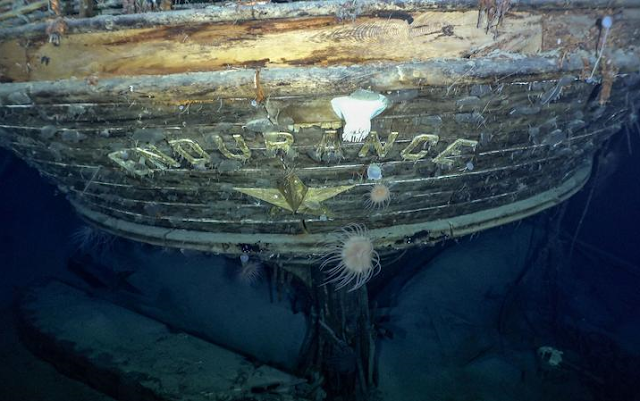
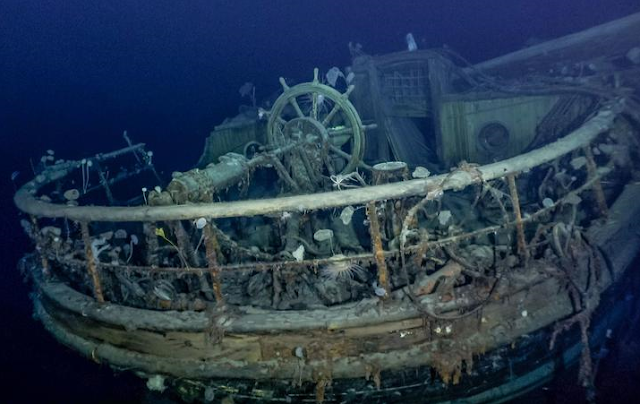
It's lovely to be distracted from all the horrible world news by the discovery in Antarctica, 3000m underneath the increasingly solid surface of the Weddell Sea, of the amazingly well-preserved wreck of the Endurance. It sank in 1915, on an ill-judged voyage towards a crossing of the continent by Ernest Shackleton - he was strongly advised not to go, because winter had started early that year, but he was stubborn and went anyway, with his crew of 27 men, 69 dogs and one cat.

The discovery was announced on the 100th anniversary of Shackleton's funeral, in South Georgia, where he had gone again to attempt another Antarctic expedition, his fourth. He died in Grytviken of a second heart attack, the first having happened in Rio de Janeiro in Brazil en route to South Georgia - which he had brushed aside. Antarctica does that to you, you know - gets under your skin, draws you back, won't let go.
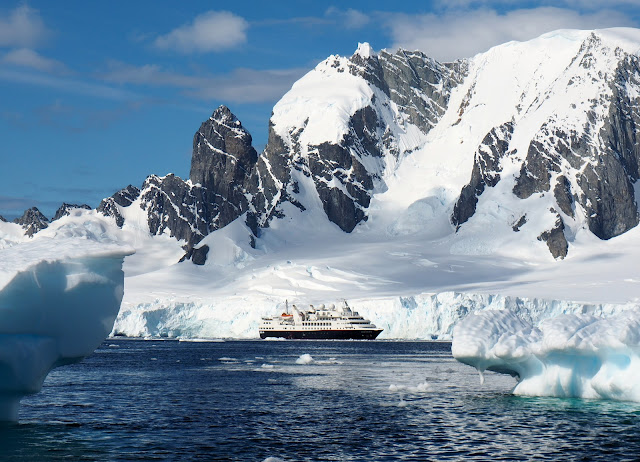
I'd go there again like a shot, offered the chance. It's unique, stunningly beautiful, and pitilessly inhospitable. On my Silversea cruise there, despite it being so expensive (*cough* to regular punters, not freebie-grabbing travel writers like me), several of the passengers guests had already been there at least once.
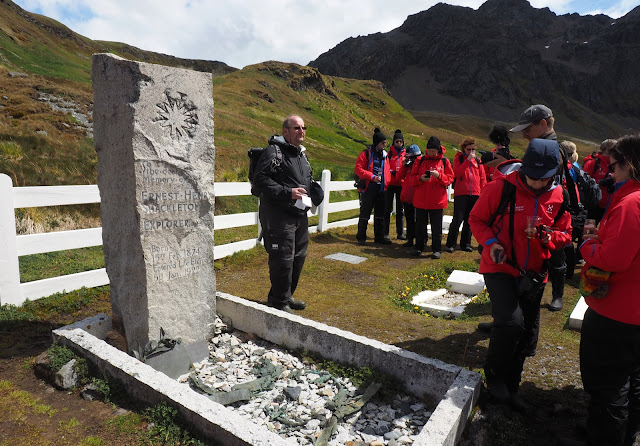
We visited Shackleton's grave there, and toasted 'The Boss' with a glass of champagne; and later visited dauntingly barren and rocky Elephant Island, where his crew had clung for four and a half unimaginably brutal months while awaiting rescue. That they were indeed all saved is due in huge part to the comparatively-unsung hero Frank Worsley - of Akaroa, NZ - who managed to navigate their little lifeboat in almost impossible conditions over 1300 stormy kilometres to South Georgia, to summon a ship for rescue. 
It's also thanks to Worsley's excellent mapping skills that the discoverers of the Endurance knew to look in pretty much the right place for the wreck. And, another Kiwi connection, one of the photography team who took these amazing underwater images of the ship is James Blake, son of Sir Peter, famous sailor, who was killed by pirates while on an expedition up the Amazon. In Brazil.

PS While writing this entry, a Silversea email popped into my inbox about - you guessed it - expedition cruises to polar regions, focussing on a giant petrel feeding frenzy in South Georgia and Zodiac explorations in Antarctica. Connections, people.

Sunday, 24 December 2017

Silver Explorer, Day 7 - A white(ish) Christmas Eve

With thanks to Silversea for hosting this cruise
There are many disadvantages to being innumerate, I have discovered. The latest is that, when your phone takes it upon itself to adopt the local, South Georgia, time – which is +1 hour – but the ship decides to keep its own time unchanged, that makes it embarrassingly difficult for some of us (see above) to work out when to set the alarm. With the consequence that I was up, showered, and half-dressed before having it brought to my attention that it wasn’t 6.30am but in fact 4.30. Sigh.
Yes, even though this is Silversea, it’s still an expedition cruise, so early starts (just not that early) and physical exertion are part of the deal. We anchored this morning in Fortuna Bay on the north coast of South Georgia in order to go ashore and get up close with the wildlife: specifically, fur seals, elephant seals and King penguins. One group was dropped off to hike to the site; the rest of us stayed on board and then Zodiac’d onto the stony beach.
We (I was in the second group – you guessed that, right?) still didn’t have it cushy because this morning it was snowing! Just little flakes that didn’t settle, but proper snow, really chilly, and with it occasional gusts of lean-against-it wind. I was very glad of my three layers of thermals and waterproofs (which had all seemed very OTT when packing back home in 22 degrees).
We did a wet landing off the Zodiac onto a beach packed with fur seals, some of which were, as predicted, not happy to see us – they humped forward and growled, showing their sharp teeth. So we scuttled past them and their wonderfully cute black furry pups (which also growled and howled and bared their teeth) and fetched up at a big colony of King penguins. They were pretty noisy too, peeping, squealing and squawking. Some were courting, others sitting motionless on eggs.
There was a large crèche of brown fluffy babies waiting for their various parents to come back with a feed for them. Their feathers were so fine and thick that they looked enormous – but last year’s brood who were busy fledging, with just patches of brown left, were much slimmer. They were the most curious about us, and came up close to inspect these strange red creatures who made all those clicking noises.
The elephant seals were moulting and not interested in us at all - they have to hang around onshore for ages while it happens so I suppose they have no spare energy for curiosity. They did do a great deal though of what sure sounded like farting but I was assured was sneezing because of mites in their nostrils.


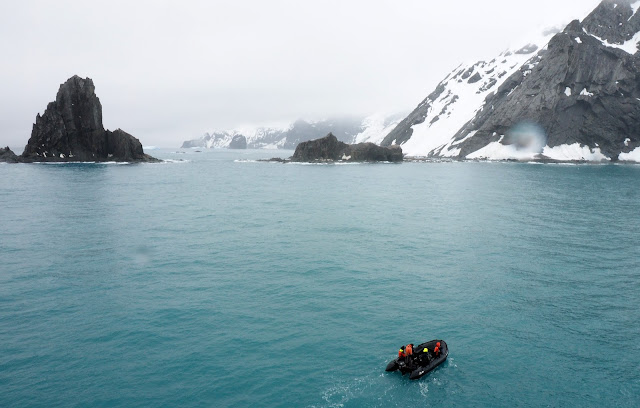
Then the sun came out and made the surroundings as amazing as the wildlife: the sea tropically turquoise, the surrounding mountains with jagged edges streaked with snow, the sky blue above it all. Glamorous.
It all made for a spectacular backdrop to our lunch back on the Explorer as we sailed to the next bay, Husvik. There are lots of Norwegian names on South Georgia, thanks to the early whalers, and in this bay is one of their processing factories, as well as a cemetery with many gravestones sunken into the peat. 
Though the rusted remains of oil tanks and machinery look picturesque, they’re too full of asbestos for us to be allowed near them, so our attention was irresistibly focused again on the penguins, feisty fur seals and the snotty, somnolent elephant seals.
One fur seal took exception to me though, as I photographed a pup suckling from his mother, and suddenly rushed at me, teeth all too visible. Instinctively, I held up my arms and shouted at him, and he stopped just a couple of metres away and I was able to scuttle away behind a group of other people and hide. It was honestly pretty alarming. “They will chase you, and they will bite you,” we’d been told.
After the evening recap and briefing (where we learned the official term “sneaky copulators” for the less dominant elephant seal males, taking advantage of the beachmaster’s attention elsewhere) we had a special Christmas Eve dinner, the staff wearing Santa hats and singing us some carols. Many of the passengers are European, and this is their custom. I chose shrimp bisque, a mulled wine sorbet and roast goose for my main course; and since it was too hard to choose between Christmas pudding, cherries jubilee and chocolate macaroons for dessert, we had all three. After all, it had been a long day…


Thursday, 4 January 2018

Silver Explorer, Day 18 - Sorry

With thanks to Silversea for this hosted cruise
The Captain warned yesterday of a gale overnight, and no-one was quite sure if it was a joke or not, because that’s how he rolls – but in fact so did the waves during what was almost the dark (further south, the sun has been setting around 11pm and rising again before 3am, and the bit in between has never even approached what you might call dark).

This morning though it was calm again, and there ahead of us, too rapidly getting larger, was land: Tierra del Fuego, and the end of our voyage. Everyone is sad about it. It really has been so special, and though some people (mainly the ones who got soaked in the downpour in Stanley while I was in the museum knowing nothing about it) would have liked a bit more sunshine, general opinion has it that we did well, seeing Antarctica in all of its moods. Well, most, anyway. I can cope without experiencing a blizzard.
When we got back to our cabins suites after breakfast, there were our suitcases laid out on the bed – a pretty brutal sort of hint. We had already received disembarkation instructions last night. There was a little note from our butler Ivy offering to do the packing. That’s an interesting concept and almost tempting, but I’m passing it by. Too many decisions that only I can make, really. And thank goodness for my expansion zips, which were the reason I bought this particular suitcase ages ago, and which it’s been ever since a mark of honour not to use. Silversea gives you a puffa jacket as well as an outer parka, both of them very well made, but they’re something else to make room for. Along with the two blouses I didn’t wear, tch.
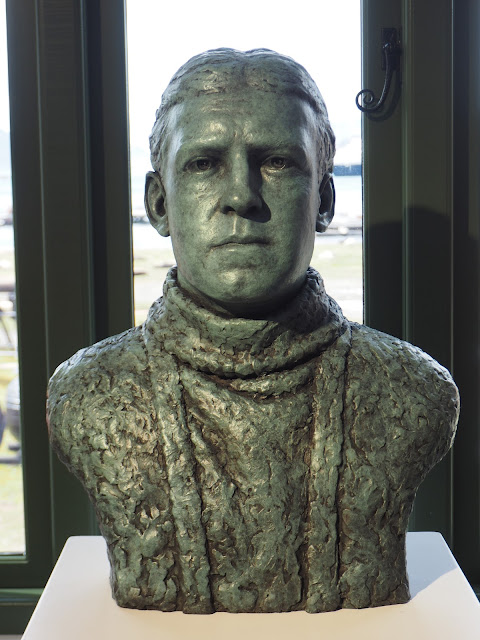
We took a break to listen to Anthony Smith’s talk about the art of bronze casting – something apparently random but which he managed to link to everywhere we’ve been – Ushuaia, the Falklands, South Georgia and even Antarctica have had bronze busts or statues that we’ve seen. The one in South Georgia was actually by Anthony himself: a bust in the museum, of Ernest Shackleton (of course). It was actually fascinating, to be shown the many stages in the process of creating a bronze, and Anthony is clearly multi-talented.
We’ve been impressed by the depth of knowledge of all of the lecturers, and have particularly enjoyed the talks by Anthony, Luke and Cory, who know their stuff inside out and communicate it intelligently and accessibly. And then it was Denis’s turn, to play the full-length version of the video he’s been compiling and without a doubt going cross-eyed and without sleep during the last couple of days to complete. Of course he has the big lenses, multiple camera bodies, and even a drone – but the talent and expertise help, too. It’s fabulous, and a wonderful reminder of the places we’ve been, the things we’ve done, what we’ve seen.

And so that was pretty much it: there was the Captain's jolly auction of that lovely map (it's gone to Chicago, for US$1300); then some drinks in the Panorama Lounge before dinner, with chairs at a premium as groups of new friends made the most of the last chance to be together; followed by dinner ditto; and then the ritual putting out of the packed and labelled suitcases before bed, and setting the alarm for the last breakfast, and the eviction at 9am as the crew work like crazy to make things ready for the lucky new consignment of passengers guests, who have all those good things ahead of them while we trudge through the tedious bits of flying back home again, our adventure over.

Tuesday, 13 February 2018

Shackleton, Scott, shrapnel and Sholes*

Skipping over for the moment the slight awkwardness of finding myself having to write advertorial for the Azamara cruise line straight after having sailed with Silversea - it's not ideal, people, the only comparison possible is not flattering to Azamara, however "luxurious" they claim to be - I was diverted to discover, nevertheless, some connections. The Silversea cruise to Antarctica, as regular readers (gidday, Queen!) will remember, was heavy on Shackleton, what with visiting his grave at Grytviken on South Georgia, and then snooping around Elephant Island and all.
Well, it turns out - and hooray for this blog, which is now indispensable as my defacto memory - that my Azamara cruise almost a year ago had its own Shackleton links too. In Akaroa, strolling back to the waterfront after my visit to the delightfully idiosyncratic - and also lovely to look at - Giant's House, I stopped to take a photo of one of that little town's characteristic pretty wooden villas. It was only then that I saw the plaque by the gate and read that it was the birthplace of Frank Worsley, the magnificently skilled captain of the Endurance on Shackleton's doomed 1914-16 exploration. It was down to him that, when six of them left the rest of the ship's crew on Elephant Island and made their run for rescue in the hastily-adapted lifeboat James Caird, he steered them, despite rough weather and almost continuous cloud cover, straight to South Georgia. Impressive. If he'd missed by even a smidgen, the boat would have headed into the South Atlantic and the whole lot of them would have died.
And then, strolling again back towards the Journey at our next stop, Dunedin, I went into the Maritime Museum in Port Chalmers and found, amongst other miscellaneous items (including a bit of shrapnel from the Japanese attack on Darwin - that's how miscellaneous) a standard issue Overseas Expeditionary Service Sholes typewriter, claimed to have been used by not only Shackleton, but also by the fated Scott. A bit more primitive than the Imperial I learned to type on, but clearly a relation.
Well, at least now, having been reminded about other kinds of cruise maritime journey, I can type on, and be a bit more complimentary about Azamara. Thank you once again, random connections.**

* Real name, as you see in the photo - so no, I didn't omit the ellipsis. Probably a good thing they went out of business before these sweary times, eh?

**Which can also be more than a bit creepy. Only this morning, reading about Chicago's blizzard and mayor Rahm Emanuel's reassurance that the city can handle it, I was remembering having shaken his hand at IPW in 2014. And when I publish today's post, what does Blogger throw up at the bottom of it as a suggestion to read? Sinister...

Thursday, 23 January 2025

Open wide


It got a bit regal in Auckland’s port today. Not just one, but two Princesses: Royal (left) and Diamond (right) (starboard?). Unusual to have two ships together from the same cruise line - I wonder if there was cameraderie or competition between the passengers? Anyway, together they poured over 6,000 people into the city, most of them seemingly queuing up to take the ferry across to Waiheke (wise decision) or wandering away along the waterfront into the Wynyard Quarter - also very pleasant on such a sunny day.

With some time to spare and spirits to bolster before a visit to the dentist, I went that way myself, to inspect the repaired pedestrian bridge that is finally in back operation. It’s pretty smart, and operates efficiently, opening up to let boats in and out of the inner harbour. I also approve of the new swimming area alongside, which was in good use, especially by kids doing manus (jumps) off the thoughtfully provided platform - pleasing that the water in the port is sufficiently clean for all that.


Though it’s always impressive, in a slightly head-shaking way, to see so many so very expensive boats of all sorts moored at Wynyard, I connected better, in the nearby Maritime Museum, with the Shackleton exhibition there. Big photos and paintings of South Georgia’s penguins, icebergs and mountains (which regular 😀 readers will recall I have seen in person), and of Shackleton and his crew, plus the incredibly primitive two-lifeboat shelter on Elephant Island (er, ditto) where they spent 4 horrendous months awaiting rescue (thanks, in huge part, to Kiwi Frank Worsley) - and also of the doomed Endurance icebound in Antarctica (*cough*). What a jaw-dropping story that is.


(Dentist visit went well, thanks for asking. No disasters of any sort today. Oh, apart from that giant iceberg that’s just been reported headed for South Georgia that’s going to maroon all the penguins and seals, and starve them to death.)


Thursday, 16 March 2017

Azamara Journey - Milford Sound

Today went from monochrome to Technicolor. We spent the night creeping around the south of the South Island, through Foveaux Strait, past the bright lights of Invercargill in the night, and along the Fiordland coast, around and up from the bottom left-hand corner (south-west to you compass nerds). Shortly after we woke, the ship was easing into Dusky Sound, to glide through the misty, moisty fiord where the tops of the peaks were hidden in cloud. People were impressed, and taking photos, but I held my peace about how Milford Sound would totally eclipse what they were seeing, and make all their pics redundant. I’m restrained like that.
Back out through Breaksea Sound onto the Tasman coast, we soon took another detour into bigger, greener Doubtful Sound for more of the same, luxuriating in the sunshine and the untouched, and untouchable, vertical native bush that could hide anything – takahe, moose, moa… There were certainly seals, as we turned into Thompson Sound to return to the Tasman.

We sailed up the coast a few hours, and I went to a lecture by an American professor about New Zealand’s self-image, fully prepared to bristle and argue, and found myself agreeing with everything he said. Good job, Allan Hanson. The ship then turned right into an unprepossessing-looking inlet, all grey and misty, and we found ourselves heading towards the light: the sun was shining in Milford Sound, the sky was blue, and those high, high, sheer rocky peaks were as spectacular as ever, trails of low cloud below the tops. 
We dawdled by a tall, graceful waterfall, watched kayaks and catamaran cruisers, small planes made to seem even smaller by the scale of the scenery, and were smug about how lucky we were to be there at all, especially in bright sunshine.
Tony the Invisible Cruise Director lived up to his name, and I found myself doing his job, telling people about the fiord, the rainfall, the freshwater layer, Mitre Peak, the Milford Track and so on. I might mention this to him, if I ever see him around the ship.

The Queenstown overnighters rejoined the ship, a piano played on the pool deck, the captain announced the strong possibility of “motion on the ocean” as we head across the Tasman Sea to Hobart, and we said goodbye to New Zealand. I think most people were pleased, on the whole, with what they saw here – though, naturally, the weather was often a disappointment on this particular cruise, what with that storm and all.
At dinner we chose to sit at a table for eight, and were joined by a couple from South Georgia, another from California, and a pair of ex-Kiwis from Melbourne. That’s the nice thing about the open-dining option on cruise ships: new people, new stories, new ideas. The not so nice bit is that sometimes your neighbour will turn from you as you’re mid-sentence, to join the conversation at the other end of the table, which he (did you guess it was a he?) had been listening to with one ear and had decided was more interesting. What, mate, the (lite version) history of Aboriginal oppression in Tasmania not dramatic enough for you? Better spend your time in Hobart drinking Cascade beer and keeping your blinkers on, then.

Monday, 25 December 2017

Silver Explorer, Day 8 - Christmas Day

With thanks to Silversea for this hosted cruise
I dunno. You grow up in New Zealand, having summertime Christmases with wintertime traditions, everything seeming upside down; and then for once have Christmas Day so far down south that there will be snow and icy winds – and what happens? You wake up to a sunny day with the temperature almost 12 degrees. It’s just not right.
It was, however, very pleasant – and even though it wasn’t a day of opening presents and eating too much, it was still one of my more memorable Christmas Days. We are in Grytviken, the nearest thing South Georgia has to a town, and it was open and ready to receive us. We anchored in the bay pretty much where Larsen did back in 1894 when he found it filled with “hundreds of whales”. Today, a few spouts blows had been seen, but the place is dominated by the machinery that processed 175,250 whales over 62 years (which, just to underline the carnage, is the number that passed through the land stations only – which was 10% of the total taken by factory ships).
It’s a pretty place, nevertheless: little white Norwegian church where you’re allowed to ring the bells; Post Office with its own stamps where you can send yourself a postcard (“It might arrive by Easter”); former manager’s house converted into an excellent museum; so many seals lying around that you really had to watch your step; picturesque shipwrecks around the shore; and mountains all around. 
We were taken around on two tours by enthusiastic locals, and heard, amongst a lot of really interesting stuff, that the three terriers we’d seen being walked through the village are Kiwi dogs trained by their Kiwi handlers to ferret out rats. There aren’t meant to be any there anymore, having been totally eradicated to the benefit of ground-nesting birds including the pipit, which we heard, the only songbird in the Antarctic region. (Reindeer have been eliminated, too.)
The main focus of the visit to Grytviken is the cemetery further around the shore: white-fenced with 20 or so gravestones within it, the biggest being Shackleton’s – his body facing south, towards Antarctica, breaking with the tradition of facing east. Alongside, on his right, are the ashes of Frank Wild, his right-hand man. We were supplied with glasses of wine or whisky, to drink a toast to ‘the Boss’.
Sailing away, we took a detour to visit the Nordenskold Glacier which reaches down to the sea where broken-off ‘bergy bits’ float around the edge.
Our afternoon stop was Godthul, where we went ashore for a hike, stepping over whale bone and around seal pups, some of them only a week old. We clambered up a hill through clumps of tussock, across shiny grass and peat bog, and then up slopes of broken slate, that tinkled quite melodiously. We had to detour around nesting giant petrels; and I marvelled, as ever, at the perversity of the Gentoo penguins who bypassed plenty of suitable sites to establish their rookery way up the hill.
Some went 100m further all the way to the top, but the rest of us then wandered back down, stopping off for a bit of bird-watching here and there and enjoying the golden light.

Christmas Day dinner, to satisfy the non-Europeans on board, offered roast turkey (though I couldn’t resist the lobster) and we ate with the staff captain, from Finland, and his daughter. We had an interesting conversation (did you know that it’s compulsory to learn Swedish at school in Finland?) but it made for a late night considering there’s a really early start tomorrow. Would you believe 4.30am?

LinkWithin

Related Posts Plugin for WordPress, Blogger...