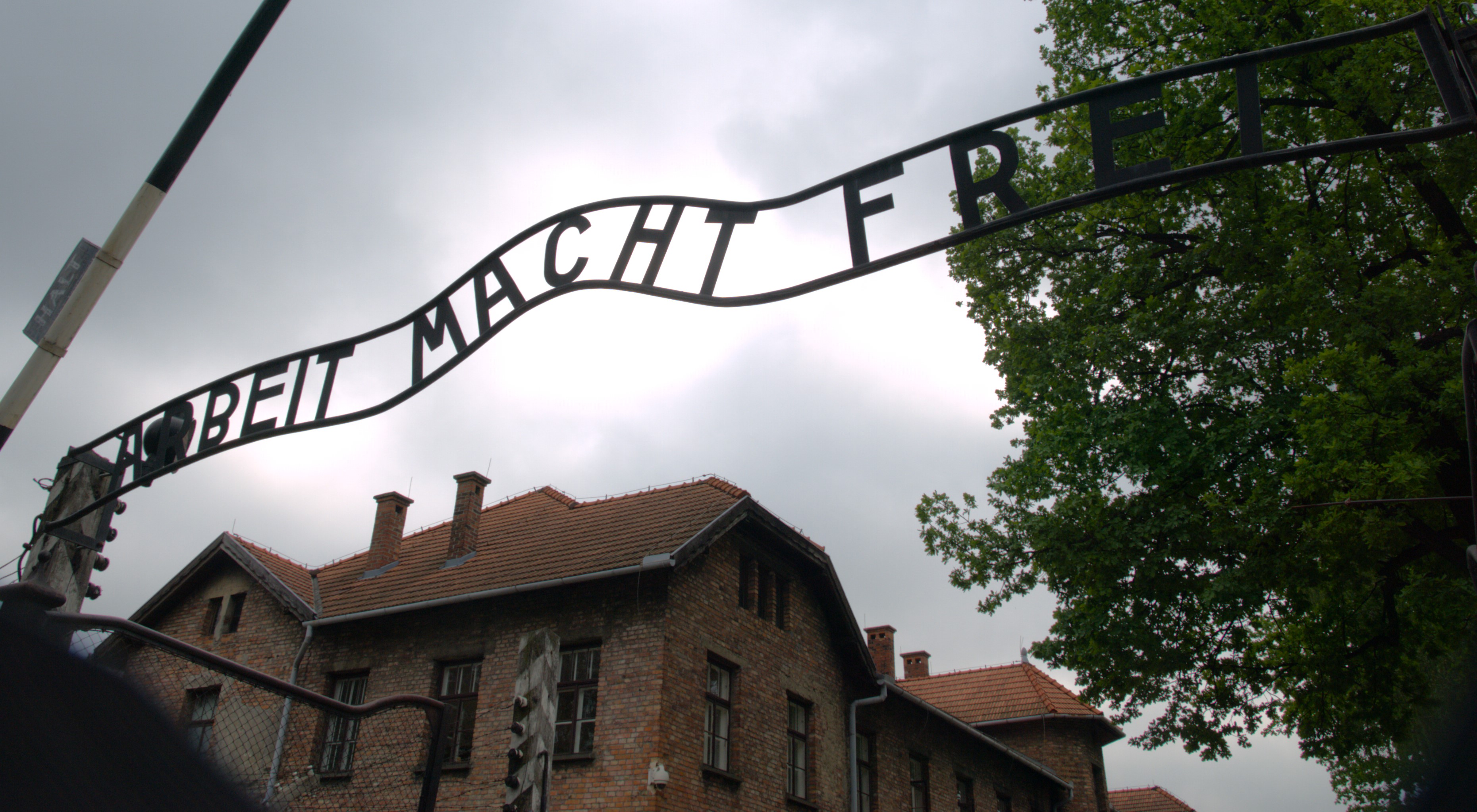
A lump of concrete in a forest; a lump of broken brick in my hand; a lump in my throat. Our visit to the site of Stalag Luft III today was moving, definitely, standing on the ground where Hut 103 once stood, walking on sand dug out of the Harry tunnel, looking at things that Dad had seen day after day during his four years in the camp - things like the brick-lined fire-fighting pond, the theatre walls, bits of broken crockery with the Luftwaffe eagle on the bottom. It was a warm and balmy day, but in winter it gets down to -20 degrees, and the pine and young oak trees growing all over the compound now weren't there to cut the icy wind back in 1942-45.
Marek, the museum director, is a man with a mission and enormous enthusiasm, spreading the word of the camps to local people and seeing it as a duty, to honour the memory of the men who were imprisoned here, and the thousands who died here. That was my surprise today: to learn about adjoining Stalag VIII C, where thousands of Russian prisoners of war endured (and often didn't) concentration camp conditions - all because Stalin wouldn't sign the Geneva Convention. It made Stalag Luft III seem a bit like a holiday camp in comparison, with no work to be done by the officers, Red Cross parcels, Shakespeare productions, model yachts on the pond, choirs and orchestras. But of course it wasn't really: there was never enough food, the boredom was epic, the cold was horrific - and the ingenuity, hard work, determination and courage involved in digging the tunnels was totally an inspiration.
Fifty of the escapers were shot afterwards on Hitler's orders, and their names are everywhere; but there was also danger in everyday life in those extraordinary times: my father was one small stroke of luck away from being shot by a guard wanting revenge for his family killed in a bombing raid. That kind of thing wasn't rare. It all seemed very real today, especially as the area is still used by the Polish tank division for training, and as we walked around we could hear gunshots and the boom of tank cannons, and saw one trundling through the trees.
It was a relief afterwards to find Zagan's pretty centre and sit with a beer and a pizza outside in the sun, joking about how glad we were that fast food is an international language; but actually thankful for so much more than that.
Showing posts sorted by relevance for query stalag luft iii. Sort by date Show all posts
Wednesday, 9 May 2012
Wednesday, 10 October 2018
Stuff Readers Rail Tour, Day 5 - Air and water
With thanks to Stuff Readers Rail Tour
Naturally, having been to the real thing, the activity offer this morning of the Antarctic Centre held no appeal, so instead I went to do something I'd never done before, despite growing up in Christchurch - kayaking along the Avon River. I went to Hagley Park to meet KT, who set up and runs ChCh Sea Kayaking. She's a real character, and the 3.5 hours I spent with her doing The Big Three tour were great fun. I should say Te Toru Nui, because she is proud of her Maori heritage and there was a Maori element running throughout, beginning with a karakia as we glided along the edge of the Botanic Gardens.
We'd clambered into the double kayak from a step she'd built herself opposite Christ's College, and which she protected from goose poo - "goose bombs" are a hazard on this activity. She'd done the safety briefing (try-hard Air NZ could learn a thing or two from her laid-back humour) and the guys in the other kayak and I felt perfectly at ease. It helps, of course, that the Avon is such a doddle, and we were going downstream on an outgoing tide - but there were distractions.
There were all the neat flowers, shrubs and trees of the Gardens, a bit of a hive of activity at the Boatshed, the tiny thrill of an even tinier set of rapids where the weir used to be, and then the sobering moment we drew alongside the Earthquake Memorial Wall. This marked our entry into the second sector of the Big Three - the city, and new territory for me since I had been punted through the Gardens before. It was really interesting to get a new angle on the city, to slide under the bridges (KT was big on testing echoes with loud cooees), look at the new and the old, the reconstructed and the still propped up, and to discover that there are eels right in the city centre.
We passed a Kate Shepherd memorial I'd never seen before ("That'll teach you guys to go to war and let us learn we can do stuff ourselves") and watched ducks with ducklings scooting across in front of us. We stopped when we got to the Margaret Mahy Playground, and got ourselves a good cup of coffee from the van there before heading off towards the third sector: the Red Zone. Here it got quieter, away from the traffic, and greener, as we passed through the suburbs that were so badly damaged in the earthquakes that the area has been completely cleared and won't be built on again. The gardens remain, though, so there are still trees and flowers, and bee hives, and walking/cycling tracks, and there are heartening plans for a recreational future.
It all looks so different that we passed the site of my school without my even noticing and before long at all were approaching the end of the tour at Kerr's Reach. There had been ducks, geese, swans, shags, eels, whitebaiters and whitebait; history, politics and opinion; some really great stories, and a lot of laughs. I thoroughly recommend a kayak with KT.
Returned by car to Hagley Park, I Ubered then out to the excellent Air Force Museum at Wigram, which was the official tour afternoon activity, and whisked around the professional displays inside the hangars. I especially enjoyed the Captured! section, which recreates the experience of a POW and includes lots of references to Stalag Luft III, with which regular readers 😀 will know I have a personal connection. And then that was it for today - good day. Thanks, Christchurch.
Thursday, 3 January 2013
Great escape, but not a great movie
Having visited Stalag Luft III last year and seen what is left of the prison camp at the museum there, as well as reading all about it for the story I wrote, it was a fascinating - if frustrating - watch. Of course, liberties were taken for story-telling purposes, I accept that; but it was a shame the compass-making wasn't shown, and that so much of the men's extraordinary inventiveness was purely background detail; plus that more of the real drama of the actual escape - the cave-ins, for example - didn't feature.
It was annoying too that some important things were wrong that should have been right: in the movie, Harry's entrance was in the shower sump - but that was Dick, which was never discovered; Harry was under a stove, which in the movie was where Tom began, instead of in a hallway. Also, the spoil from the tunnels was bright yellow sand, much more treacherous to dig and more difficult to dispose of discreetly than the brown dirt in the movie. And of course, no Americans took part in the actual escape, as they'd been moved to their own compound by the time it took place.
All the post-escape part of the story was, while diverting, pure "Hollywood ballyhoo" as Dad described it; and I do wonder why the order to murder 50 of the escapers was ascribed to "a higher authority" rather than to Hitler specifically - what, sparing his feelings, were they? Altogether, I'm glad the movie was made, and allowed the public to know something of the event - but it's time for a re-make, one that's more accurate and instead of making up stuff, values the drama of the real-life stories. Peter Jackson, are you twiddling your thumbs now The Hobbit is finished? How about it?
Wednesday, 8 August 2012
Lucky numbers
Though it's still cold and rainy, I noticed this morning that there's a light yellow rim around all the puddles - pine pollen, so spring can't be too far away. Still fully focused on Stalag Luft III, which was built in the middle of a coniferous forest, it made me wonder if Dad was glad to see the pollen too, knowing the hard winter must be coming to an end - or maybe he thought, "Another spring, and I'm still here." Probably both, but being the pragmatic sort, it would have been the end of winter that mattered more: Marek told us it gets down to around -15 to -20 in Zagan.
It was already pretty cold when Dad was captured in Nantes in November 1941. When the Germans burst into the flat where he and his sergeants were being hidden, he shot upstairs and laid low all day, creeping out at night when the coast seemed clear. He could have sneaked away but, lightly dressed, all he could think about was retrieving his greatcoat. It was comic-story stuff: he shinned up a drainpipe and in through a window to his room, where in the dark he trod on a Bakelite cup which woke the German soldier asleep in his bed. That winter, when he said, "I shivered for three solid months" (it was the coldest of the War), I bet he thought of that greatcoat often, shut in his solitary cell at Fresnes prison near Versailles, with ice on the walls and only a bowl of cabbage soup and a square of bread to eat once a day. Being a guest of the Gestapo really sucked.
The Luftwaffe were much better hosts - not that any of the airmen were tempted to stay, constantly trying to escape even as they were herded into the camp (like cats). I keep learning more stuff about the Great Escape: while we were celebrating her share of a Lotto First Division win last week, my sister said that Dad had told her once that his number, 129, wasn't the one he originally drew. He was afraid that, being tall and broad-shouldered, he might have trouble squeezing through the tunnel and cause a cave-in (two did happen that night) and hold up the whole operation, so he swapped his low number for a higher one. A book I've been reading, The Longest Tunnel by Alan Burgess, said that the compass-makers were amongst those in the draw for places 50 to 70 - so his original number could have made him one of the 76 who escaped. And, consequently, one of the 50 of those who were shot.
It was already pretty cold when Dad was captured in Nantes in November 1941. When the Germans burst into the flat where he and his sergeants were being hidden, he shot upstairs and laid low all day, creeping out at night when the coast seemed clear. He could have sneaked away but, lightly dressed, all he could think about was retrieving his greatcoat. It was comic-story stuff: he shinned up a drainpipe and in through a window to his room, where in the dark he trod on a Bakelite cup which woke the German soldier asleep in his bed. That winter, when he said, "I shivered for three solid months" (it was the coldest of the War), I bet he thought of that greatcoat often, shut in his solitary cell at Fresnes prison near Versailles, with ice on the walls and only a bowl of cabbage soup and a square of bread to eat once a day. Being a guest of the Gestapo really sucked.
Thursday, 6 August 2009
Connections
It's one of the main glories of Auckland, that we have beautiful sandy beaches edging all the suburbs - usually pretty sheltered and safe (the surfies have to go over to the west coast for the wild black-sand beaches) and always a balm for the eyes and soul. Only a balm, etc, at the moment - but that's still worth a lot.
Yesterday I was in Takapuna, where I love to go shopping simply because I can be buzzing along the road between boutiques and cafes and there, at the end of the street, is the sea, blue and shining, with always a yacht gliding past. It's lovely.
Takapuna Beach is long and broad at low tide, and Charles Kingsford Smith landed his plane the Southern Cross there in 1932, a stop on his tour around the country celebrating, amongst other notable firsts, his pioneer flight across the Tasman. When he got down to Dunedin, my father, a boy, was thrilled to win a lucky draw for a joy-flight with him. It gave him the flying bug and led him to leave the farm when he was older to go to Christchurch to take lessons. Then the war began, he joined the Air Force, went to Britain and met my mother, crash-landed on a bombing mission over northern France, was helped by the Resistance, captured by the Germans and ended up in Stalag Luft III in Poland, the Great Escape prison camp, where he spent the next 4 years.
He disliked talking about it, and there's a lot we don't know, but I would like one day to make a sort of pilgrimage to Sagan. My nephew has been, and says the pine forest has grown back over the site of the camp, but still...
Most people look down The Strand and just see a beach.
Saturday, 26 May 2012
Heil hope, dashed
This trip has been so focused on the war, or wars, partly through choice, with visiting Stalag Luft III, but mostly because that's simply how it is in Europe, that today in Munich I just went with the flow and topped it all off with a Third Reich walking tour. Berlin is the other half of that story, of course, but Munich is where it all began and Eric (from the US) was a well-informed and interesting guide around the significant locations. Few are more significant than the upper hall of the Hofbrauhaus where every night tourists come to bend their elbows and sink a few steins in rowdy jollity, most of them probably in total ignorance of the fact that just above their heads is where Hitler announced the birth of the Nazi Party.
It was a very odd feeling to sit there and listen to the familiar story and know it had taken place on that very spot. Even more unexpected, though, was when we left to follow the path of the march of the Beerhall Putsch that took place three years later, from the Hofbrauhaus to the Odeonsplatz, and Eric described how the marchers had been fired on by soldiers. As he told the story, Hitler's bodyguard, "a big, fat Bavarian", flung himself on top of Hitler, taking four bullets for him "which didn't kill him, because of the fat" but in the process dislocating Hitler's shoulder.
Well! I never expected to feel any sympathy for Adolf Hitler, but just for a moment, I actually did. And immediately, I wanted to know which shoulder it had been. "No-one's ever asked me that before," said Eric, "but it was probably the left, because of the salutes." That was exactly why I was asking, of course - remembering all those crisply raised right arms, I wanted hope that my rapidly withering arm has a normal future ahead of it. But no. Scheisse. So afterwards I went to a Biergarten for some elbow-bending of my own. The left one.
It was a very odd feeling to sit there and listen to the familiar story and know it had taken place on that very spot. Even more unexpected, though, was when we left to follow the path of the march of the Beerhall Putsch that took place three years later, from the Hofbrauhaus to the Odeonsplatz, and Eric described how the marchers had been fired on by soldiers. As he told the story, Hitler's bodyguard, "a big, fat Bavarian", flung himself on top of Hitler, taking four bullets for him "which didn't kill him, because of the fat" but in the process dislocating Hitler's shoulder.
Well! I never expected to feel any sympathy for Adolf Hitler, but just for a moment, I actually did. And immediately, I wanted to know which shoulder it had been. "No-one's ever asked me that before," said Eric, "but it was probably the left, because of the salutes." That was exactly why I was asking, of course - remembering all those crisply raised right arms, I wanted hope that my rapidly withering arm has a normal future ahead of it. But no. Scheisse. So afterwards I went to a Biergarten for some elbow-bending of my own. The left one.
Tuesday, 31 July 2012
POWs, penguins and P/Os
Again with the coincidences. Here I am, boring restaurant story done and dusted, busily researching the next one about Stalag Luft III, when what do I see in today's paper but a report about the discovery in Fremantle, WA (where I've been) of the grave of one of the Great Escapers, S/L Leonard Trent, VC. [That's Squadron Leader, to you civvies - I'm down with all these abbreviations now: G/C, F/L, S/L... and P/O like my father - Pilot Officer.] I've just been reading about how Trent had got out of the tunnel and crawled through the snow into the trees (a triangulation error meant the tunnel surfaced 10m short of the treeline) when the guard discovered the tunnel and the game was up. He surrendered straight away, wise man.
One of those who got away was another New Zealander, Johnny Pohe, a Maori, who was in the same room as Dad. He was caught a few days later. Just 22 years old, he was murdered by the Gestapo on Hitler's orders, one of the 50 who were made an example of, in contravention of the Geneva Convention. Though only 3 made it safely home, the escape succeeded in its prime objective which was to disrupt the war effort - and infuriated Hitler, who wanted all 76 escapers shot. Surprisingly, it was Goering who persuaded him to moderate that; our guide at the SL3 museum in Zagan told us that actually he got Hitler to agree to 50% of the escapers shot, but somewhere along the line the % got lost - and so an extra 12 men died.
I also learned yesterday, poking through my father's stuff and listening to a recorded interview with my nephew Scott, that Dad not only worked on magnetising razor blades for compass needles, but also did his bit as a Duty Pilot look-out and as a penguin scattering sand from bags down his trousers, as well as taking stints pumping air through the klim-tin pipe in the tunnel - very hard work, that was. And as well as all that activity in the North Compound, when he was in the East Compound earlier, being big and strong, he was one of the men who carried out the vaulting horse that concealed a tunnel being dug there in plain view of the guards: the famous Wooden Horse. It was quite an achievement, to carry it as though it was light, when it was concealing one, sometimes two men, plus all the sand they'd excavated.
I do so wish Dad were still alive, so I could talk to him about all this. Or even, just talk to him.
One of those who got away was another New Zealander, Johnny Pohe, a Maori, who was in the same room as Dad. He was caught a few days later. Just 22 years old, he was murdered by the Gestapo on Hitler's orders, one of the 50 who were made an example of, in contravention of the Geneva Convention. Though only 3 made it safely home, the escape succeeded in its prime objective which was to disrupt the war effort - and infuriated Hitler, who wanted all 76 escapers shot. Surprisingly, it was Goering who persuaded him to moderate that; our guide at the SL3 museum in Zagan told us that actually he got Hitler to agree to 50% of the escapers shot, but somewhere along the line the % got lost - and so an extra 12 men died.
I also learned yesterday, poking through my father's stuff and listening to a recorded interview with my nephew Scott, that Dad not only worked on magnetising razor blades for compass needles, but also did his bit as a Duty Pilot look-out and as a penguin scattering sand from bags down his trousers, as well as taking stints pumping air through the klim-tin pipe in the tunnel - very hard work, that was. And as well as all that activity in the North Compound, when he was in the East Compound earlier, being big and strong, he was one of the men who carried out the vaulting horse that concealed a tunnel being dug there in plain view of the guards: the famous Wooden Horse. It was quite an achievement, to carry it as though it was light, when it was concealing one, sometimes two men, plus all the sand they'd excavated.
I do so wish Dad were still alive, so I could talk to him about all this. Or even, just talk to him.
Monday, 14 January 2013
Dry teeth
The thing about doing a loop-the-loop in a wee yellow bi-plane is that it gives you dry teeth. As the view up over the little windshield becomes nothing but blue sky and cloud and then, most startlingly, upside-down river and paddocks and roads, while the straps bite into your hips and shoulders and your stomach gives a bit of a lurch, you either gasp or, er, exclaim, or shriek or grin. Generally all of those, in that order, I would guess: that's how it was for me, anyway. And all that open-mouthed stuff plus the rush of the wind leaves you with dry teeth. And a great feeling of exhilaration.
We were at the Croydon Aircraft Company near Mandeville, where a small team of calm and multi-skilled workers in overalls painstakingly restore old wood-and-fabric aircraft for rich men. We saw all sorts of machines in various stages of repair, many of them just metal frameworks with a few panels of moulded plywood applied, awaiting their turn for attention or, quite often, the next injection of cash from their besotted owners. In a nearby hanger were the finished results, a selection of Moths (did you know that besides Tiger and Gypsy, there are Puss, Fox, Dragon and Leopard?) plus other types, all neat and tight and airworthy.
Then we went outside and Ryan strapped me into the front seat and we took off without ceremony, flying over the lush Waimea Plains with their slashes of windbreaks, and the braided river, before looping up and over and down and up again, and then doing a wing stall with a moment's disconcerting silence from the engine. It was so thrilling, I couldn't stop grinning. So that's how I got dry teeth today at 1000 feet above sea level. And made another connection with my father, who first learned to fly in a Tiger Moth not so very far north of here, the first step in a journey that ended for him in Poland at Stalag Luft III - where, last year, I also followed him.
We were at the Croydon Aircraft Company near Mandeville, where a small team of calm and multi-skilled workers in overalls painstakingly restore old wood-and-fabric aircraft for rich men. We saw all sorts of machines in various stages of repair, many of them just metal frameworks with a few panels of moulded plywood applied, awaiting their turn for attention or, quite often, the next injection of cash from their besotted owners. In a nearby hanger were the finished results, a selection of Moths (did you know that besides Tiger and Gypsy, there are Puss, Fox, Dragon and Leopard?) plus other types, all neat and tight and airworthy.
Then we went outside and Ryan strapped me into the front seat and we took off without ceremony, flying over the lush Waimea Plains with their slashes of windbreaks, and the braided river, before looping up and over and down and up again, and then doing a wing stall with a moment's disconcerting silence from the engine. It was so thrilling, I couldn't stop grinning. So that's how I got dry teeth today at 1000 feet above sea level. And made another connection with my father, who first learned to fly in a Tiger Moth not so very far north of here, the first step in a journey that ended for him in Poland at Stalag Luft III - where, last year, I also followed him.
Tuesday, 8 May 2012
Mentioning the war
But of course a World War (or two) that killed millions is another matter altogether, especially when that includes the Holocaust. I was quite impressed this morning when I was photographing (badly - broken shoulder, remember) a bronze sculpture of children that we came across by chance in a side street off Friedrichstrasse near the station, which commemorates the Kindertransport. That was the sending of 10,000 Jewish children to England in 1938-41 - the lucky ones, that is. Other trains took other children to places like Auschwitz. I learned this thanks to the passing German lady who took my arm and led me to read the nearby story boards that accompany the sculpture. She's got her handling of history sorted, it would seem.
And tomorrow is going to be all about the war, as I visit the remains of a prisoner of war camp hidden in the pine trees that line the bumpy roads here in western Poland. My father spent four years of his early 20s there, hungry, bored, frustrated and no doubt sometimes fearful for his safety - with good reason, as we discovered after his death. I wonder what else I may learn tomorrow.
Tuesday, 6 June 2023
Oestrogen rules!
I was going to revisit here a train trip I took from New Delhi to Agra, way back in 1980, prompted by the appallingly tragic triple train crash that's just happened in India. But of course that would be somewhat appalling too - insensitively trivialising and tone-deaf. So instead I'm going to write about war as a tourist attraction.Today is the anniversary of D-Day, after all. And who hasn't done a tour of northern France and not been to the beaches, visited Dunkirk, been awed by the white crosses stretching away into the distance at the cemeteries, marvelled at still being able to see the remains of the Mulberry harbour at Arromanches? It's hugely sobering to see it all, stand on the edge of a bomb crater, read the info boards, and imagine the horror of it all - but it's also, be honest, fascinatingly interesting, dramatic and thus, yes, entertaining.Wherever you (ie I) go in the world, there are wartime (and worse) 'attractions' - I honestly couldn't count the battlefields and war cemeteries I've visited, from Gallipoli to Gettysburg, Adelaide River to Bourail in New Caledonia. Plus Stalag Luft III and, even worse, Auschwitz and the Hanoi Hilton. These places have an irresistible appeal that's a weird combination of honest reverence and regret for all those lives lost and pain inflicted, and a creepy fascination for viewing the utter depths of cruelty that men (it's always men) are driven to by their overwhelming desire for power and territory.And, though I suppose it's possible to travel the world and have holidays that don't include stuff like this, it's always there, pretty much wherever you go. The tourist industry isn't backward in pointing that out and, yes, exploiting it openly with focussed tours and suchlike. Their main customers are, of course, Baby Boomers, whose parents lived through WW2 - I wonder, once we've all shuffled off , whether younger generations will be quite so interested?I'm guessing yes. After all, war has been a constant throughout human history, and is certainly front-and-centre right now, with the distinct possibility of others looming, despite the deservedly quite distracting threats of climate change. Do you ever wonder how different things might have been/might be if there were a bit less testosterone swirling through the people in charge around the world?
Sunday, 7 September 2014
With gratitude to the French
Thanks to the glories of Google, two model enthusiasts in Brittany have found me and told me about the diorama that one of them is making of the scene of the plane sitting in the shallow waters of the bay, with the three crew making good their escape. The modeller had had another project in mind until his friend told him about this event, which he knew about in full detail, because his grandmother was one of the primary helpers in hiding, moving and looking after the men. I knew her name too, because in the report Dad wrote as soon as he was liberated and returned to England in 1945, he names her, and clearly admires the spirit and bravery shown by all the women who helped them.
When the Germans caught the three airmen six weeks later in Nantes, where the Resistance had moved them, intending to get them to Spain and thence to England, the women were arrested too. They were taken to Ravensbruck concentration camp in northern Germany, which was unusual in being for women and children only. Over 130,000 people were sent there during the war, and only 15,000 to 32,000 survived. There were medical experiments, exterminations, starvation and disease - towards the end, 80 died every day. Knowing that, it's especially hard to read Dad's description of them when by chance he saw them in Angers as he was being loaded into a bus to be taken to Fresnes prison in Versailles and then, eventually, to Stalag Luft III:
Mme de St Laurent's grandson sent me a clipping from the local paper last year, reporting that a plaque was to be erected in the alleyway in St-Efflam that leads to the beach where Dad and his crew waded ashore to hide, initially, in the roof of a hut. And this week I received a photo taken recently of the plaque by a visiting Kiwi who knew the story, and came prepared with an Anzac poppy. It feels so right to see it, and to know that those courageous women have been remembered and honoured for their sacrifice. If it weren't for them, I wouldn't have a father. In fact, I wouldn't be here at all.
Monday, 31 December 2012
2012, wrapped up
The most remarkable thing about this year is that I didn't go to Australia. (I'm still feeling that I've used Oz up - although I'd be happy to be proved wrong. Anyone listening? Kimberley cruise, Kakadu, Maria Island, WA for the wildflower season...?)
I did pass through, though, a number of times, on my way to more distant destinations; but my first travels this year were domestic, first to old favourite Waiheke Island, just across the harbour but in another zone entirely, ambience-wise. Beautiful, relaxing and laid-back, it never fails to please - even when the weather disappoints.
Home again after 5 weeks away, I was anchored to the sofa for the next three months, writing, writing, writing with a cat at each side and a dog at my feet. I popped down to Christchurch for a look at my sadly shaken hometown, and was both horrified and inspired by what I saw - the vast empty spaces, blowing with dust, and the cracks in everything; but also the optimistic spirit of the people I met, and their bright plans for the future.
September saw the start of another flurry of travel, beginning with flying with Emirates to Dubai again, where I went up to the 124th floor of the Burj Khalifa, and on to Portugal for a scant 5 days mostly in the province of Alentejo where I loved the fortified hilltop villages, the gnarled olive trees, the sheep with bells on and the friendly people; but hated the food-focused itinerary and unprofessional behaviour of one of the small party.
Back home for one night, I was away again next day for a week of glorious relaxation in the Cook Islands, purely a holiday of lying about, sleeping in the sun (not recommended: the sunburn was epic and I still bear the unsightly tan-marks) and doing very little of anything. Stand-out was the day spent cruising on and wallowing in the WMBL (world's most beautiful lagoon) at Aitutaki - just perfect, in every way.
After a fun day out on the train down to Matamata for a look at the obsessive detail of Hobbiton, the year finished back on the sofa with, sadly, just the one cat now at my side. I've had 49 stories accepted for publication, about half of those in the NZ Herald, as well as writing around 30 blog entries for Air France and others for the Yahoo! website. I've been to lunches and dinners and a cooking class, learned how to take the top off a champagne bottle with a sabre, had massages, ridden a camel and a Segway, eaten insects as well as fabulous meals, and been given a huge and beautiful bouquet for my services to Australian tourism, having had over 100 stories published about that immense country. Ironic, or what?
It's been a good year and I've been to some amazing places, met lots of lovely people and written masses of stories (if you're interested in reading some of them, click on the links over there to the right). It's been busy, and tiring sometimes, but I've loved it and am looking forward to more of the, er, different: Alaska, maybe? Africa? Who knows - can't wait to find out. Watch this space!
Friday, 17 May 2013
No prize, but a consolation
My certificate arrived this morning, posted because also-rans don't get any moments of glory at the presentation evening, which is a slick if rowdy affair during which 50+ gongs are handed over in double-quick time, to allow for plenty of drinking afterwards, presumably. Shame about the typo*, eh? Kind of takes the shine off it; and as for the 'Power of Journalism' claim - somewhat enfeebled, I feel. (Bitter, me?)
*Kindly and apologetically fixed, quite quickly.
The story was the one about my visit to the site of Stalag Luft III in Zagan, Poland, which you can read here, and was my second runner-up of the week, having had another three days earlier at the Cathay Pacific Travel Media Awards with this one about Parihaka. This is not meant as skiting, this time (nb blog title) because there's no unalloyed joy in coming second, no matter how many unrecognised entrants stand behind you. I don't want to sound churlish, but everybody knows winning is best.
However. The prize for the 2013 Cathay Pacific/Travcom awards is somewhat less generous than previously - when I won four (sigh) years ago, it was a trip for two to India, business class, with a five-day private tour of the Golden Triangle. This year it's four days of sightseeing for one person in Hong Kong, with a possible upgrade to business, and accommodation at the Peninsula. Well, it would all have been a bit deja-vu: though I only had [skite alert] two nights (pre-Silversea cruise, not as a prize) at that splendid hotel, it was in a 6-room suite with a telescope, we were met at the airbridge by the hotel person, were driven there in a Roll's Royce and had a degustation dinner in the three restaurants. What fun it all was! It would have been such a shame, to spoil that first fine careless rapture by a sordid repetition. Wouldn't it?
The story was the one about my visit to the site of Stalag Luft III in Zagan, Poland, which you can read here, and was my second runner-up of the week, having had another three days earlier at the Cathay Pacific Travel Media Awards with this one about Parihaka. This is not meant as skiting, this time (nb blog title) because there's no unalloyed joy in coming second, no matter how many unrecognised entrants stand behind you. I don't want to sound churlish, but everybody knows winning is best.
However. The prize for the 2013 Cathay Pacific/Travcom awards is somewhat less generous than previously - when I won four (sigh) years ago, it was a trip for two to India, business class, with a five-day private tour of the Golden Triangle. This year it's four days of sightseeing for one person in Hong Kong, with a possible upgrade to business, and accommodation at the Peninsula. Well, it would all have been a bit deja-vu: though I only had [skite alert] two nights (pre-Silversea cruise, not as a prize) at that splendid hotel, it was in a 6-room suite with a telescope, we were met at the airbridge by the hotel person, were driven there in a Roll's Royce and had a degustation dinner in the three restaurants. What fun it all was! It would have been such a shame, to spoil that first fine careless rapture by a sordid repetition. Wouldn't it?
Subscribe to:
Posts (Atom)